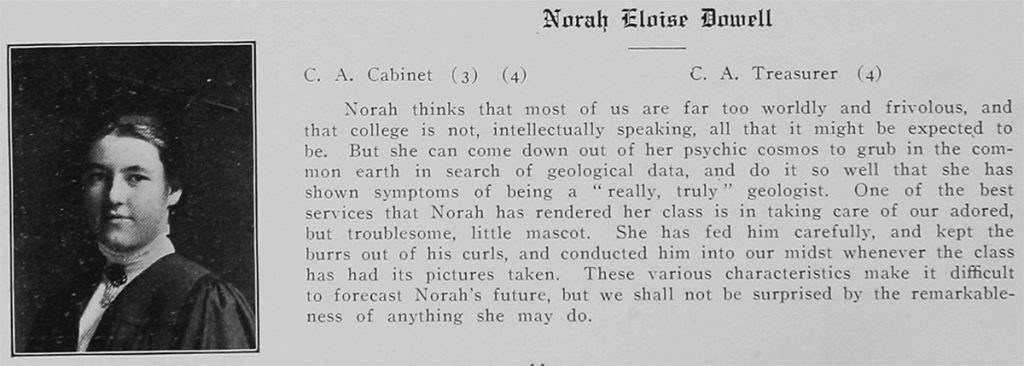
Norah Dowell Stearns was an American hydrogeologist and may have been the first woman to be employed as such. Born in Rhode Island in 1891, she attended Brown University for both her undergraduate degree (1913) and her Ph.D. in geography (Dowell, 1916). Part of her yearbook entry reads, “But she can come down out of her psychic cosmos to grub in the common earth in search of geological data, and do it so well that she has shown symptoms of being a ‘really, truly’ geologist. […] we shall not be surprised by the remarkableness of anything she may do.”
From 1924 she worked for the United States Geological Survey. She was part of the Groundwater Division (Stearns, 1938), directed then by Oscar Meinzer. She probably met the geologist Harold Thornton Stearns (1900–1986) there, whom she married in 1925. They had two children: a son, Stanley Stearns (1926–2013), and a daughter, Dorothy E. Stearns (born in 1927 in California). For work, they traveled as a family through the west of the United States and then lived in Hawaii from 1930 to 1938 or 1939. This information comes from biographies of her son, Stanley, known for drawing stamps (Brook man stamps, 2019; Russel Fink Gallery, 2019; Worth Point, 2019) rather than any dedicated to Stearns herself, demonstrating that you can have been a brilliant scientist, your papers cited hundreds of times in scientific literature and been remembered mainly because you had a son.
Indeed, she is cited in Hydrogeology in the United States 1780–1950 only in the erratum (Davis and Davis, 2005), stating that “numerous contributions of Norah Dowell Stearns should have been included under item (j) on page 128” (i.e. in the specific section on women and hydrogeology). However, the work she and her husband did at least partly together in Hawaii is detailed in the main text as attributed to him.
Even her husband mentioned her only twice in his autobiography: once by her name while describing the USGS Groundwater group at the beginning of the 1920s, the second time only as “my wife” in a meaningless anecdote from 1930 (Stearns, 1983). From 1938 he mentions his second wife Claudia (not much more often than Norah). It seems likely that she appears in a video with him, “Mauna Loa Volcano Hawaii — 1930s Eruption” (at 3:55 and 4:40) but is uncredited in the archive entry.
Between 1927 and 1938, she authored or co-authored at least 13 scientific publications about geology, especially the formation of the Hawaii islands (1935a, b; see image below) and Guam (1937a, b, 1938) as well as hydrogeology. She is the co-author of an important hydrological balance of the Pomperaug basin (Meinzer and Dowell Stearns, 1927), and conducted work on the quantification of hydraulic conductivity (Dowell Stearns 1927 a). She is also sometimes mentioned as the co-author of 2 other works, “Geology of reservoir and dam sites – geology of the Owyhee irrigation project” and “The Thiem method for determining permeability of water-bearing materials: and its application to the determination of specific yield: results of investigations in the Platte River Valley, Nebraska.”
textbook written by Stearns
She collaborated several times with Oscar Meinzer, the pioneer of hydrogeology in the United States: they authored 3 papers together, and he supervised part of her work for her first 1927 paper, according to Meinzer himself (Meinzer and Fisher, 1934). She collaborated with another woman, Margaret Foster, who did the water analysis of the Pomperaug basin study (1927). In 1937, she co-authored another book, this time on the thermal springs in the USA, with her husband and another scientist, Gerald A. Waring (Dowell Stearns et al., 1937). Her publications have been cited hundreds of times, often in the 1940s, 1950s, and 1960s but also later, including several times from 2000 to 2016, proof of her overlooked yet lasting legacy in the field.
The last paper she is known for certain to be the author of is from 1938, the same year she got divorced. She is then mentioned in a 1940 US census as living in Seattle with both her children. It appears that around this time she left the USGS and began working for the Office of Strategic Services (OSS), which was formed in WWII as a precursor to the CIA, and continued there until 1962. Further details of her later life and her date of death are currently unknown, but it appears she did live up to the prediction in her yearbook: she was a remarkable geologist.
—
Post by Aude Vincent
https://www.researchgate.net/profile/Aude_Vincent2
Edited by Suzie
Images of Stearns courtesy Brown University Library Special Collections, from the 1913 Brun Mael Yearbook and used with permission.
Attested bibliography of Norah Dowell Stearns
– Dowell, Norah E.: Some Phases of the Economic Geography of Rhode Island: A Study of Response to Geographic Environment, Ph.D. thesis, Brown University, Unites States of America, 1916.
– Meinzer, Oscar E., and Stearns, Norah Dowell: A study of groundwater in the Pomperaug Basin, Connecticut, US Geological Survey Water-Supply Paper, 2309, 73–146, available at: http://pubs.usgs.gov, 1927–1929. cited 73 times
– Stearns, Norah Dowell: Laboratory tests on physical properties of water-bearing materials, US Geol. Survey, Water Supply Paper, 596, available at: http://pubs.usgs. gov, 1927. cited 72 times
– Collins, W. D., Fiedler, Albert, Hall, George, Howard, C., McCombs, John, Meinzer, Oscar E., Riffenburg H., and Stearns, Norah Dowell: Contributions to the hydrology of the US, USGS, 1927.
– Stearns, Norah Dowell: Report on the geology and groundwater hydrology of the experimental area of the United States Public Health Service at Fort Caswell, NC., Washington: Government Printing Office, Hygienic laboratory bulletin, 147, US Treasury Department house document, 597, 1927.
– Stiles, Charles Wardell, Crohurst, H. R., Thomson, Gordon E., and Stearns Norah Dowell: Experimental bacterial and chemical pollution of wells via groundwater, and the factors involved, Bulletin, Hygienic Laboratory, U.S., 147, 1927.
– Bryan, Kirk, Grover, Nathan Clifford, McGlastein, Harry D., Meinzer, Oscar E., Stearns, Harold T., and Stearns, Norah Dowell: Contributions to the hydrology of the US, USGS, 1928.
– Stearns, Norah Dowell: Annotated Bibliography and Index of Geology and Water Supply of the Island of Oahu, Hawaii, U.S. Geological Survey, Bulletin 3, 78 pp., available at: http://pubs.er.usgs.gov, http://evols.library. manoa.hawaii.edu, 1935.
– Stearns, Norah Dowell: An island is born; Oahu roars up from the deep to claim its place in the Hawaiian group of Polynesia; a story of geological genesis, Honolulu, Hawaii: Honolulu Star-Bulletin Company, Ltd, 1935.
– Stearns Norah Dowell: Significance of limestone in Guam, Guam Recorder, 14, 3, 28-43, 1937. cited 1 time
– Stearns Norah Dowell: Explosive volcanic rocks of Guam, Guam Recorder, 14, 4, 36–37, 1937. cited 1 time
– Stearns, Norah Dowell, Stearns, Harold T., and Waring, G. A.: Thermal springs in the United States Geological Survey, available at: http://books.google.com, Water-Supply Paper 679-B, 206 pp., 1937. 4 editions were published in 1937, held by 157 WorldCat member libraries worldwide
– Stearns, Norah Dowell, Pillow lavas of Guam, Guam Recorder, 14, 7–8, 1938. cited 2 times
References:
Norah Dowell Stearn’s publications, and:
Brook man stamps – A little history on the 22ND (1955–56) duck stamp artist, available at: http://www.brookmanstamps.com/Netcat/federal/rw22info.htm, last access 2019.
Davis, S. N. and Davis A. G.: Hydrogeology in the United States 1780–1950, Department of Hydrology and Water Resources, University of Arizona, Tucson, p. 140, 2005.
Meinzer, O. E., and Fisher, V. C.: Tests of permeability with low hydraulic gradients, Reports, and papers, Hydrology, 1934.
Russel Fink Gallery: Stearns, Stanley, available at: https://store.russellfinkgallery.com/stearnsstanley.htmlT, last access 2019.
Stearns, H. T.: Memoirs of a Geologist: From Poverty Peak to Piggery Gulch, Hawaii Institute of Geophysics, USA, 1983.
Worth Point – Four 1971 Artist Proofs STANLEY STEARNS, available at: https://www.worthpoint.com/worthopedia/four-1971-artistproofs-stanley-20697111, last access: 2019.