

Tucked within the busy streets of Rada, Yemen sits the 15th-century palace of Amiriya Madrasa, named for the last Sultan of the Tahirid Dynasty: Amir ibn Abd Al-Wahhab. Killed in 1517, Al-Wahhab’s successors left the Amiriya Madrasa, causing the beautiful domed palace to fall into ruin over the next five centuries. When first discovered, the Madrasa was thought to have been a school (madrasa being the Arabic word for school) but was later confirmed as a palace with its own small mosque attached. Lost to history, the architectural wonder of limestone and brick became the town’s dump, with years and years of dust, dirt, and trash covering up the past.
That was until Dr. Selma Al-Radi picked up her trowel (or dental tool) and took matters into her own hands.
Born the daughter of an Iraqi ambassador on July 23, 1939, in Baghdad, Al-Radi spent much of her childhood in India. She obtained her BA in Oriental Studies from the University of Cambridge and soon after started work at the National Museum of Iraq. She and her cousin, Lamya Gailani, were the first women in Iraq to excavate for the archaeological service. During this time, they found a cache of what is now known as the Nimrud Ivories, intricately carved ivory from the 9th to 7th centuries.
She went on to obtain her Master’s degree from Columbia in Art History and Archaeology, and then her Ph.D. at the University of Amsterdam, researching a Bronze Age site in Cyprus.
In 1977, she became an advisor to the National Museum of Yemen in Sana’a, where she was hired for restoration and cataloging. During her time there, she came across what would become known as the pièce de ré·sis·tance of her career: the remnants of the Amiriya Madrasa. Inspired and emboldened, Dr. Radi reached out to a Dutch archaeological team that was working in the region.
“I saw this building and said, ‘Wow, this we’ve got to save.’ Dr. Radi told The Guardian in 2006. ‘So I went rushing back to the Dutch Embassy and said, ‘Help, help, help.’” (NYT)
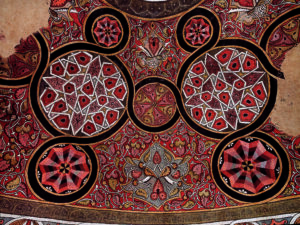
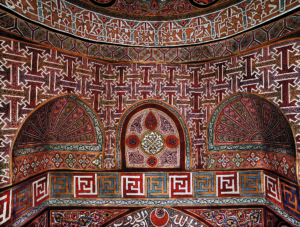
Restoration began in 1983, the primary focus making sure the Madrasa would not collapse due to disrepair. In doing so, Dr. Radi reinvented the lost art of qudad, an ancient type of waterproof brick building with volcanic ash and slaked lime. Coupled with using only traditional methods as well as local workers, Dr. Radi kept the entire 25-year restoration project at $2 million dollars. With the integrity of the building preserved, Dr. Radi turned her attention to the murals, carvings, and other artwork. There were some 40 murals in the mosque, and stucco carvings of floral and geometric designs decorated the ceiling. Motifs of Quranic passages in red, orange, and green tempura flowed throughout the halls, though most were covered in layers of whitewash.
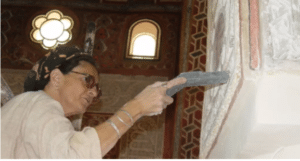
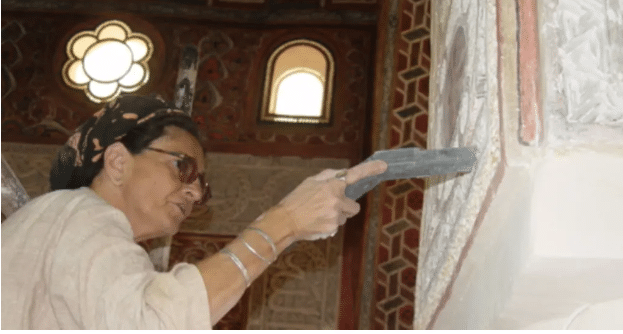
Dr. Radi at work on the Madrasa. Image used with the kind permission of Qais Al-Awqati
While Dr. Radi personally scraped away at the whitewash with dental tools-a herculean task that took 15 years!- a team of art restorers from the Centro di Conservazione Archeologica in Italy worked on the murals and taught local Yemeni scholars in the ‘art’ of art restoration.
02 04 2005 008
02 04 2005 007
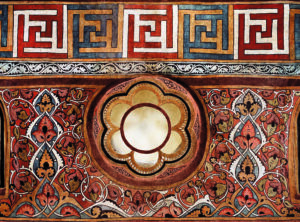
Madrasa artwork after restoration. Images used with permission of CCA Roma: Centro di Conservazione Archeologica https://ccaroma.org
The Amiriya Madrasa reopened in 2005, almost 25 years after its restoration began. It is open to the public, save for prayer times, and has a museum dedicated to its history and restoration. In 2007, Dr. Radi and her colleague, Yayha Al-Nasiri won the Aga Khan Award for Architecture, for their work on the Madrasa. She published two books on the subject: “The Amiriya in Rada: The History and Restoration of a Sixteenth-Century Madrasa in Yemen” (Oxford University, 1997; edited by Robert Hillenbrand) and “Amiriya Madrasa: The Conservation of the Mural Paintings” (Centro di Conservazione Archeologica, 2005; with Roberto Nardi and Chiara Zizola). Dr. Radi passed away in October 2010.
An incredible Trowelblazer, Dr. Selma Al-Radi is remembered as an advocate for the forgotten, and for the use of traditional methods and local labor. Her reuse of qudad and other traditional methods created a new Amiriya Madrasa plucked straight from the pages of history books.
Dr. Radi did, however, use one historical inconsistency: electric light. But perhaps it wasn’t all that inconsistent: Yemeni legend speaks of the last Sultan ordering servants to place lanterns in every window of the Madrasa, riding out on the hills to look upon its splendor glowing in the night. And while the servants, Sultan, and Dr. Radi are gone, the Madrasa remains, glowing in the night as it did so many centuries ago. And if you go high on the hills surrounding Rada, you can see the lights shining like ghosts of the past that maybe aren’t ghosts at all, but rather reminders of the beauty of yesterday, and the influence of one woman in her crusade for the preservation of history.
Read Selma Al-Radi’s obituary in the New York Times here.
See Al-Bab’s appreciation post here.
Written by Libby Grace Garrett


Such a hardwork for stunning results , simply amazing! Congratulations to all involved! Keep it up. With compliments.