
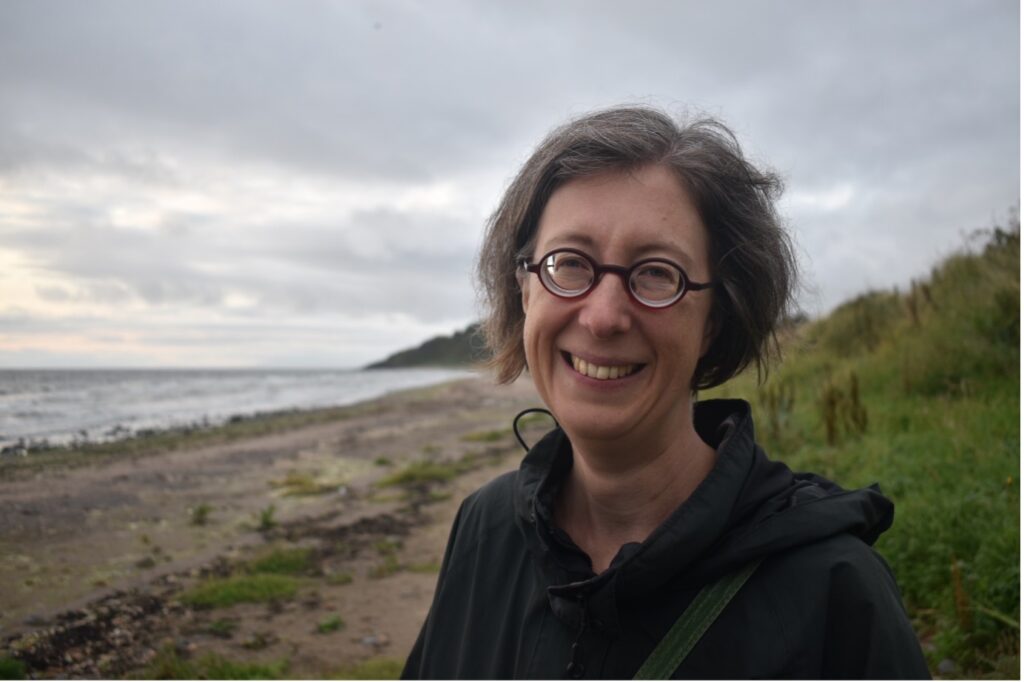
Katharine MacDonald (Kathy) was an archaeologist specializing in the Palaeolithic period, and especially the Neanderthals. She did her most important work not with a trowel, but through careful study of pre-existing literature to construct databases, exploring the complex factors in the evolution of humans and their extinct relatives. Her work was widely impactful in painting the big picture of how humans have moved through, adapted, and adapted to, new and changing landscapes.
Born in Glasgow in 1976, from her early days, Kathy was drawn both to the arts and the sciences (her mother Margaret, a Professor of art history and her father, Norman, a Reader in theoretical physics, both at Glasgow University, Scotland). Her first archaeological job involved drawing wall stones at an excavation at Dunure on the Ayrshire coast, and summers spent digging at Whithorn in Galloway convinced her to become an archaeologist. Kathy first studied at Oxford, followed by an MSc in Archaeological Computing and then a PhD at Southampton University. She was interested in using mapping software and biological statistics to explore which aspects control how primate species are distributed in landscapes. Thinking about geography in human evolution become one of her cherished research topics, whether for the earliest hominins Africa, or the first occupations of Europe more than half a million years ago.

Kathy (on left) in 2013 looking at the 330,000 year old spears from Schöningen, Germany, at the RGZM collections, along with Dafne Koutamanis, then a Masters student.
In 2004 Kathy began postdoctoral research at the Faculty of Archaeology, Leiden University, in the Netherlands. By doggedly digging through digital databases on hunter-gatherers, and ‘excavating’ ethnographic studies in a variety of languages, she produced a cross-cultural study on the knowledge and skills required for this way of life, including how it is passed from one generation to the next. This was the beginning of a long career at Leiden (in addition to six months as a postdoc at the Romano-Germanic Central Museum, Mainz, Germany), including a position as Lecturer. Kathy collaborated widely in her goals to address questions about vanished landscapes, early human populations and how they adapted to Europe’s ecology of high seasonality and intense cold. She was especially interested in how making and using fire was part of being human, and published key papers on this including on Neanderthals and landscape modifications by fire, raising great interest from scholars and the general public alike. The future of our planet was high on Kathy’s agenda, within and outside her academic life, and she was strongly convinced about the relevance of the past for creating a liveable planet, focusing on this theme in her most recent teachings
Kathy’s interests in the broadest questions in human evolution, yet with a a very careful eye for details, led to her supervising many students from undergraduates to PhDs. Amongst her colleagues at Leiden and beyond, she was held in high regard for her research, and also for her calm, generous character. Yet despite her achievements, brilliant scholarship and dedication to the discipline, Kathy – soft-spoken and unpretentious – did not gain the rapid career advancement one might expect, and she remained on temporary contracts throughout her career. Nevertheless, when in 2022 a few days after her 46th birthday Kathy’s life and career were ended suddenly by a bacterial infection, the outpouring of expressions of loss and appreciation from colleagues and friends at Leiden and abroad demonstrated that she had indeed created a powerful legacy, both in terms of her research, and as a model of gracious academic practice.

Watercolour by Kathy MacDonald: seashore near Aarhus, Denmark, June 2022.
Kathy’s scholarly and artistic interests combined in exploring places and landscapes at the edges of habitability, and she sought to grasp how people made such places home, and to sit with the beauty of bleakness. A gifted artist, she always carried her sketchbook with her, and would sit unnoticed at field trips, excavations and conferences, turning her observations of landscapes, people, and things into beautiful drawings and watercolours; these are another of her lasting legacies. The watercolour included in this article was made a few weeks before her passing; it depicts the seashore near Aarhus, Denmark, where she worked with colleague Trine Kellberg Nielsen on a paper about the geographical range of Neanderthals.
Post written by Wil Roebroeks and Alec Badenoch; edited by Becky Wragg Sykes


