Dr. Grace Anne Stewart was the first woman in Canada to receive a B.A. in geology, though sexist attitudes at Canadian scientific institutions drove her to pursue a career in the United States. Stewart grew up on a farm near Minnedosa, Manitoba, where she had ample opportunity to explore the sedimentary geology of the region growing up. It is highly likely that fossil-bearing outcrops in the region, along with her academically-inclined upbringing, inspired Stewart to become the first woman to achieve a B.A. in geology at the University of Alberta and to later specialize in paleontology. Stewart later achieved an M.A. in geology at the University of Alberta in 1920 and a Ph.D. at the University of Chicago in 1922. Keep in mind that these were both American institutions and that Stewart was actually encouraged to become qualified for high-importance jobs, unlike Dr. Alice Wilson whose Ph.D. was delayed by her Canadian employers for purely sexist reasons.
Dr. Stewart spent the summers of 1922-23 in the collections of the Geological Survey of Canada’s National Museum (now called the Canadian Museum of Nature) as a curator, however, the hostile environment toward women at the GSC meant that she was unable to secure a permanent position. Stewart was overqualified to be hired permanently at the GSC since her Ph.D. would have made her eligible for the highest scientific positions at the Survey. The sexist attitudes and policies enforced by W. H. Collins, the director of the Survey at the time, are well-documented, and he spent much of his career actively hindering those of the women who worked for him. Instead, Stewart obtained a permanent position in the Ohio State University Department of Geology and has been claimed by the United States as one of their earliest female geologists despite her Canadian origins. There, Stewart specialized in Devonian and Silurian invertebrates and microfossils of Ohio. She conducted both educational and museum duties, presenting papers before the Paleontological Society, her work often being described as “meticulous.” She returned to the GSC temporarily for the summer of 1928, and took a brief position in Calgary after her retirement in 1954, indicating that Stewart might have had the desire to work in Canada (even though she despised the winters!), and might have been persuaded to remain there had the scientific community been more welcoming to female scientists.
Stewart was an active member of the Faculty Women’s Group of Ohio State, even acting as chair for one year, indicating that she, like Dr. Alice Wilson, had a keen interest in helping women succeed in academia and science. When Wilson published her children’s geology book in 1947, “The Earth Beneath Our Feet,” and thanked Dr. Grace Anne Stewart in the acknowledgments as a major contributor. Stewart was known to inspire enthusiasm from her students at Ohio State, effectively influencing a generation of young geologists to respect women as leaders in the field.
Her legacy lives on in the Grace Anne Stewart Speaker Series at the University of Alberta, which aims to celebrate diversity within the fields of Earth and Atmospheric Sciences.
Post by Brigid Christison, @Brigidomorpha
Edited by Suzie
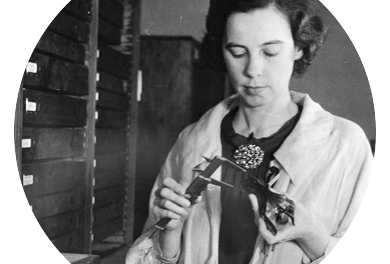
Image from Stewart’s GSA obituary and reproduced under fair use.