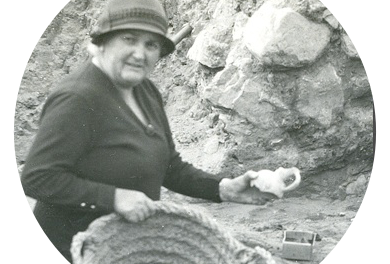
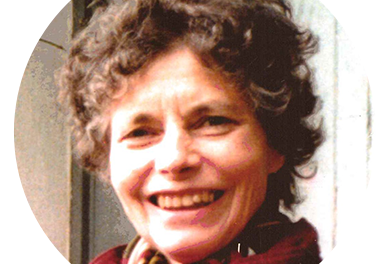
Elena Kuz’mina (13 April 1931 – 17 October 2013) was a Russian archaeologist and the chief research officer of the Russian Institute for Cultural Research. She led twenty five archaeological expeditions and participated in over one hundred research projects, mostly in the Eurasian steppe region. Beginning in 1956, she began to work in the Neolithic and Bronze Sector of the Institute of Archeology of the USSR Academy of Sciences in Moscow. By 1958, she was appointed head of the Emba detachment, which studied the contact zone between Europe and Asia. That same year, she headed the Elenovsky detachment of the Orenburg expedition, whose goal was to complete the first comprehensive study of Bronze Age monuments in the Orenburg region. It was during this period that she began to focus on the role of metallurgy and transportation in the economies and connectivity of prehistoric Bronze Age cultures. She received her Candidate of Science degree in archaeology in 1964 with her dissertation, “Development of the production of metal products in Central Asia in the era of the Eneolithic and Bronze” at Moscow State University, and her Doctor of Science in 1988 on “The material culture of the Andronovo tribes and the origin of the Indo-Iranians”.
From 1986 she worked at the Institute for Cultural Research in Moscow, and in 1999 she became a full professor of Archaeology there, a post she held until her death in 2013. She was a member of the Russian Academy of Natural Sciences (1988), Corresponding Fellow of the German Archaeological Institute (1982), member of the Italian Società Iranologica Europea (1996), and of the European Association of South Asian Archaeologists.
All in all, she published more than 300 articles and 15 books over the course of her career. Her most notable work in English was ‘Origins of the Indo-Iranians’ which was an expanded version of “Откуда пришли индоарии” (Where did the Indo-Aryans come from?) (Moscow, 1994). This book decisively added her voice to the debate on the origins of the Indo-Iranians as well as the Indo-Europeans and argued for the importance of migrations as a source of cultural change and technological innovation. Importantly, this work included an examination of the Andronovo horizon, an important culture group of the Late Bronze Age that was present across much of the Central Asian steppe (~1800 to 1500 cal BCE), which she later expanded in her work, ‘The Prehistory of the Silk Road’ (2008). Elena Kuz’mina focused on highlighting variation within the Andronovo horizon based on differences in material culture between regions, while simultaneously suggesting that the disparate populations were still related both genetically and linguistically. Her interpretation of prehistoric steppe cultures produced canonical work that later scholars have used as a jumping off point for their own research.
Post by Alicia Ventresca Miller, @steppebioarch
Selected works:
Kuzmina, E. E. (1994) Where did the Indo-Aryans go? (MGP Kalin VINITI RAN).
Kuzmina, E. E. (2008) The prehistory of the Silk Road. (University of Pennsylvania Press).
References:
Okorokov, A.V. (2013) ЕЛЕНА ЕФИМОВНА КУЗЬМИНА [Elena Efimovna Kuz’mina]. Journal of Cultural Research 13:3. http://cr-journal.ru/files/file/04_2014_20_34_17_1398443657.pdf
Fair use image of Elena Efimovna Kuz’mina from Wikipedia.