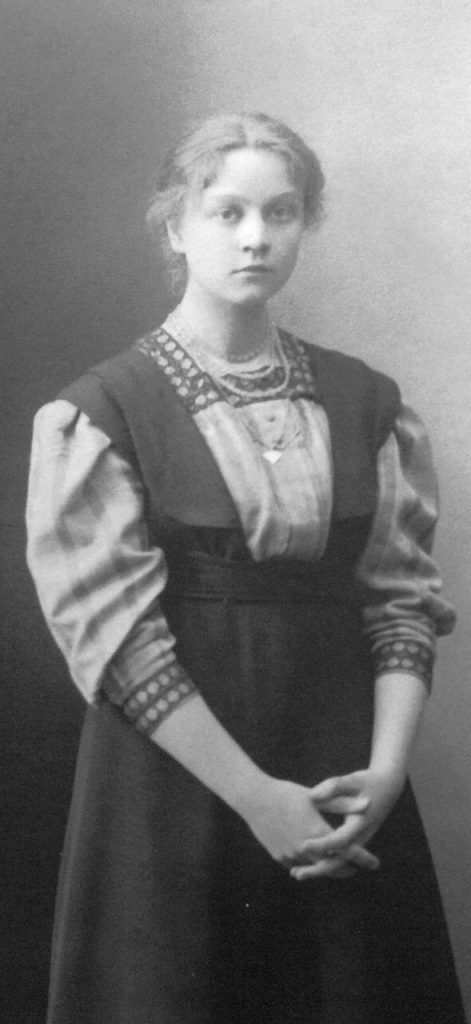
Over the course of her career, Kamilla Vasil’evna Trever wrote overarching syntheses of the material culture of the Iranian world, Central Asia, and the South Caucasus. She was a serious student of forgotten places- the regions on the frontier of the Russian speaking world. In each of her research spheres, she produced seminal works that remain important texts to this day.
Born in St. Petersburg in 1892, Trever received her secondary education at the German-language Petrischule, and subsequently enrolled in the Women’s Pedagogical Institute (1907-1912) and then the history department at Bestuzhev Courses (1912-1915), the preeminent women’s education institution in imperial Russia, passing her exams at St. Petersburg State University in 1914. In her time at the Bestuzhev Courses, she was taught by some of the foremost Russian specialists in ancient history and archaeology, including M.I. Rostovtzeff, B.V. Farmakovsky, I.M. Grevs, and F.F. Zelensky. During her tertiary education, she had the opportunity to travel to Italy, Greece, and Crimea — paying for her travel herself through work as a secondary school tutor. She began her archaeological career with material from Crimea in 1913, under the direction of Farmakovsky. A gifted linguist, she also participated in a collaborative translation of Lucian during World War I. Later in life, she would go on to learn a number of other languages, including Armenian, Syriac, and Persian.
Her major scientific contributions began after she was elected as a research fellow at the Imperial Archaeological Commission in 1918, and began her work at the Hermitage. But before describing those, there is one exceptional detail from her early years. Trever, along with a group of friends from school and from Bestuzhev Courses, founded and performed in Heptachor, a dance group and studio inspired by the work of Isadora Duncan and drawing on motifs of the ancient Greek world. The studio they founded functioned through the early Soviet period, offering performances through 1934.
Her work at the Hermitage began in the Greek-Scythian department and brought her into the orbit of I. A. Orbeli, with whom she would have a lifelong collaboration, despite their very different academic styles – they were described as being in a “beautiful duet” of specialists on the ancient east («…в этот прекрасный востоковедный дуэт…»). Her early days at the Hermitage, however, were colored by the challenges of the post-revolution years: when skilled typesetters could not be find to layout the pages of the first issues of the new Soviet scientific journal “Izvestia RAIMK,” Trever and other volunteers, organized by Orbeli, learned how to typeset and accomplished the project on themselves.
Working in the Hermitage’s collection in the 1920s, Trever focused on the first of her central academic contributions: work on Sasanian toreutics and numismatics, and pre-Islamic Iranian material culture and history more broadly. She also published on material from excavations in Mongolia, and taught in the Iranian Studies faculty of Leningrad State University. By the 1930s, Trever’s second research focus was emerging: Central Asia, and particularly Hellenistic Bactria. The publication of her 1940 monograph «Памятники греко-бактрийского искусства» [Monuments of Greco-Bactrian Art] was summation of this work. Her skills as an organizer also emerged during these years. She was the force behind the 3rd International Conference in Iranian Art and Archaeology (Leningrad, 1935), which is remembered as a watershed moment for Soviet studies on Iran and the Near East.
World War II changed her career trajectory. After helping to pack the Hermitage’s collections to prevent wartime damage, she was sent to Uzbekistan, where she worked at the Institute of Language, Literature, and History. She was one of the editors on the series «Истории народов Узбекистана» [The History of the Peoples of Uzbekistan], and wrote significant parts of the first volume. After about two years in Central Asia, she was seconded to the Armenian branch of the Academy of Sciences, where she worked alongside B.B. Piotrovsky and Orbeli. Here, she started to work on the third of her major research contributions: scholarship on the ancient and medieval archaeology and history of the South Caucasus. Eventually, she published a monograph on Armenia in 1953, and a second on Caucasian Albanian in 1959.
Having been elected as a corresponding member of the Academy of Sciences in 1943, she returned to Leningrad following the end of the war. There, she helped to restore the museum’s exhibitions, and played an active role in the training of the next generation. Her research continued, chiefly focused on the Hermitage’s collection, and on the cultures of the South Caucasus. After leaving the Hermitage in 1960, she remained a vibrant presence among Leningrad’s scholarly circles and continued to work at the IIMK and the Institute of Oriental Studies, maintaining far-reaching connections with colleagues from her years in Central Asia and the Caucasus until her death in 1974.
Post by Lara Fabian
References
1. Груздева, Е.Н. 2009. “Камилла Васильевна Тревер. К 120-летию со дня рождения.” Universum: Вестник герценовского университета, no. 8.
2. Заднепровский., Ю.А. 1995. “Камилла Васильевна Тревер.” Российская археология, no. 4: 240–44.
4. Гептахор
The image of Kamilla Vasil’evna Trever is used with permission from the Petrischule archive.