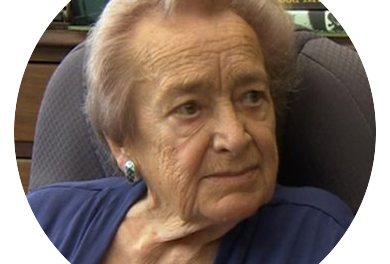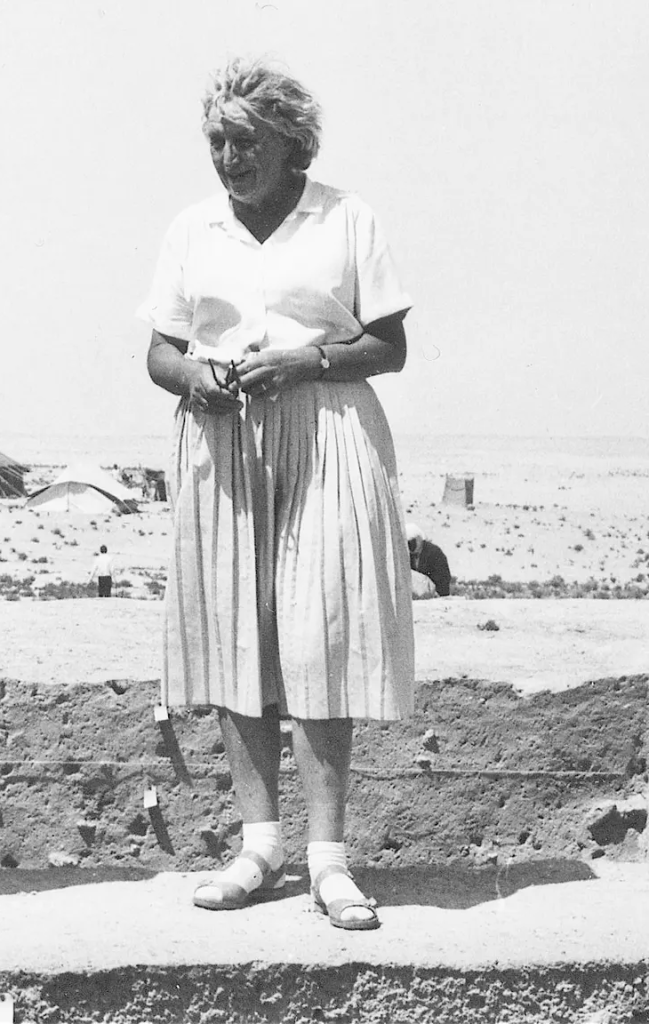
Diana Kirkbride-Halbaek has been described as one of the last grandes dammes of British archaeology; comparisons with Gertrude Bell and Kathleen Kenyon are inevitable. Highly intelligent, self confident, not one to suffer fools and never happier than with a cigarette in one hand and a gin and tonic in the other, she died in Denmark on 13th August 1997 at the age of 81 still planning a further season of work in Jordan.
She was born in Southampton on 22nd October 1915, growing up both there and in Norfolk. During World War 2 she served in the Women’s Royal Naval Service and became interested in archaeology from books she found in the WRNS library at their base in Southampton.
After the war, she developed this interest, studying full-time for a post-graduate diploma in Egyptology at University College London. She was excused the need for a first degree because of her war service and was awarded her diploma in 1950. She subsequently studied Mesopotamian archaeology under Sir Max Mallowan and Dame Kathleen Kenyon at the Institute of Archaeology in London.
In 1951 she briefly studied in Egypt, going on to become a site supervisor at Kathleen Kenyon’s excavation at Jericho, where she would work from 1952-1955. Her time there was significant and a springboard for the rest of her career. For example, in 1953 she met Gerald Lankester Harding, the director of the Jordanian Department of Antiquities. Under his guidance, she took on a number of field projects in Jordan; the most significant of which was the restoration of the South Theatre at Jerash in northern Jordan. It involved her overseeing the excavation of the site and the reconstruction of columns and amphitheatre seating, a remarkable piece of work for such a young archaeologist. The Theatre is today a major tourist attraction with an annual arts festival.

The ‘Treasury’ at Petra. Image from Wikimedia Commons by Boris Debic. https://commons.wikimedia.org/wiki/File:Al_Khazneh_(The_Treasury)_in_Petra_view_from_above_2.jpg
In 1956 she went to Petra in southern Jordan. At the time there had been little archaeological survey work done in the surrounding area. She excavated at Petra and a number of Paleolithic and Neolithic sites nearby, including a Palaeolithic rock shelter called Wadi Madamagh and a small Neolithic site called Beidha that now forms part of the Petra World Heritage Site. In 1958, with help from the British School of Archaeology in Jerusalem, she began excavation work which continued until 1967. During that period she spent many months alone there with only the company of the Bedouin who became her trusted friends. Also working on the team at Beidha was the Danish palaeobotanist Hans Helbaek, whom she married in 1964.
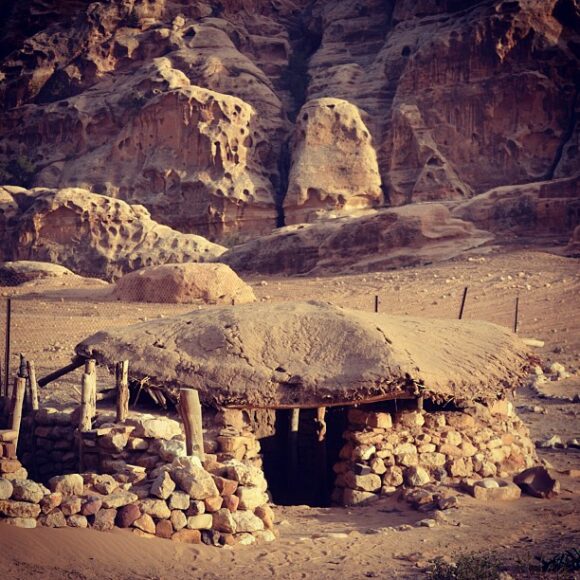
Reconstruction of a roundhouse at Beida. Image by Brenna
Towards the end of this period she was appointed director of the British School of Archaeology in Iraq (Gertrude Bell Memorial). From her new position in Baghdad she began explorations in northern Mesopotamia. These resulted in the discovery of another Neolithic site in north western Iraq called Umm Dabaghiyah, a settlement spanning the period from 6200 to 5750 BC.

Diana Kirkbride (far right) at Umm Dabaghiya in 1971 after a desert storm.
In the late 1970s she moved to Denmark. She had spent most of the previous 20 years living and working in the Middle East, having been involved in work in Lebanon, Turkey and Cyprus, as well as Jordan and Iraq. In recognition of her work she was awarded the University of Oxford’s Gerald Avery Wainwright Fellowship in Near Eastern Archaeology and the Fellowship of the Society of Antiquaries.
Hans Helbaek died in 1981 and she herself suffered a stroke around this time. Nevertheless this did not deter her – in 1983 she returned to Beidha for one final season. Subsequently she continued to collaborate on final publications for Beidha and Umm Dabaghiyah with plans for new field work.
She often visited London in her latter years entertaining old friends and colleagues to drinks at the University Women’s Club, her husky, raucous, smokey laugh ringing out over talk and gossip about old times and her fascinating experiences.
—
Post by Martin Eade
Images provided by Ann Seawright and used with permission.
Edited by Suzie