
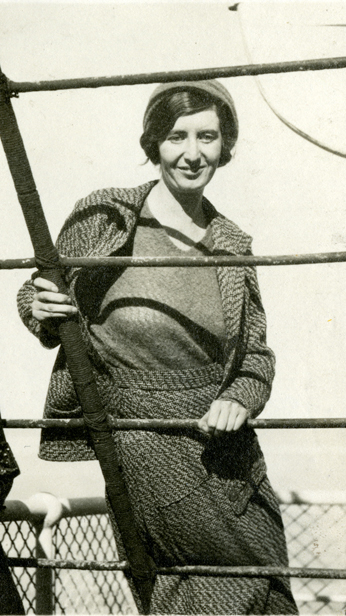
We are extremely lucky to be able to offer you an inside look at a brand new OPEN ACCESS book on the adventures of TrowelBlazer Olga Tufnell, one told in her own words. Carefully collected together by researchers Jack Green and Ros Henry, this is the chance to hear and see a hundred-year old adventure through a woman’s eyes.
Olga Tufnell’s ‘Perfect Journey’
By Jack Green and Ros Henry
Olga Tufnell (1905‒1985) was a British archaeologist who mainly worked in Palestine in the 1920s and 1930s, whose archive of letters and photographs are housed at the Palestine Exploration Fund, London. She is best known for her scholarly publications on the excavations of Tell ed-Duweir (ancient Lachish), as well scarabs and stamp seals from the East Mediterranean. You can read her full TrowelBlazers bio here. Tufnell’s reminiscences and letters provide insights into dig life during the so-called “golden age” of archaeology in the Holy Land, and the wider cultural, political, and gendered context of fieldwork within Mandate Palestine.
In our new open access book entitled Olga Tufnell’s “Perfect Journey.” Letters and Photographs of an Archaeologist in the Levant and Mediterranean (UCL Press), we present her letters from this period for the first time. They provide a personal account of her experiences, shedding light on travel and dig life during extraordinary times.
The letters offer insights into social and professional networks and the history of archaeology. They provide a contemporary view of the role of foreign archaeologists, relationships with local workers and their families, and the colonial frameworks within which they operated. The letters are important because they give Olga Tufnell’s viewpoint as an individual at times and places which saw significant social and political change. The letters reflect the attitudes of the day: some static and resistant to change; others indicating the growing acceptance of women in a man’s world.
Dig Life

Olga Tufnell and workers at Tell Fara, February 1929. From a print made by Camerascopes Ltd, labelled ‘Tracing Defense of Shepherd Kings’. Original photograph by Richard St Barbe Baker. © Estate of Richard St Barbe Baker, reproduced courtesy of Hugh Locke. Digitized from original print, courtesy of Rachael Sparks.
The central aspect of Olga Tufnell’s time in Palestine was archaeological excavation and documentation of artefacts which came out of the ground. These projects required large workforces and a skilled labour force. Flinders Petrie had brought experienced workers from Quft in Egypt to dig in Palestine as they established excavations at Tell Fara and Tell el-‘Ajjul in the 1920s and 1930s. Yet there remained a major shortage in labour filled by local Arab villagers (Fellahin) and Bedouin who were trained as workers, including women and children. Tufnell became close to many of her Arab workers, often helping them to learn English, and in turn they helped Olga with Arabic. Wherever possible, the workers’ names are included in the book alongside the foreign team members.
There are insights in the letters about the responsibilities and the huge task at hand and the organization of labor at the sites they worked at. This letter was written soon after she began at Tell Fara, near Gaza:
“Work is in full swing and I am out on the cemetery all day. We have now got 47 skulls and are only waiting for more to turn up to complete the round 50. There are 2 Quftis and about 50 men and boys on my beat, my job is to keep the boys at it and to record anything that turns up and be on the spot generally. The Arabic moves on now that I hear little else all day, and have to try to make myself understood. You should have seen me sacking a boy yesterday, nobody was more surprised than myself. It was a fine sight; the men are very good workers and really reliable, and Mr S. [Starkey] does the rounds frequently.
The day is pretty full up, we come in for lunch at twelve till one and then carry on till sunset. After that there is drawing to be done and general clearing up until bedtime.” – Khan Yunis, S. Palestine. 13 January 1928.
The Camp Clinic
In addition to the packed fieldwork schedule, Tufnell also contributed to public health efforts within rural areas that had limited access to hospitals or clinics. She ran a camp clinic at Tell el-‘Ajjul and Tell ed-Duweir, providing treatment for malaria and eye diseases to local workers and their families, and anyone else who visited. She writes in one letter to Dr. John Strathern of the St. John Eye Hospital in Jerusalem:
“I am now seeing between 30 and 40 people a day here, and a large proportion of them are eye cases, funnily enough one of the Kubeibe [Qubeibeh] men actually saw me when I was at the hospital in my white coat, so my prestige is slightly higher than it should be!” –Tell ed-Duweir, February 9 1933.

Olga Tufnell administering eye drops outside the dispensary at Tell ed-Duweir. Photo by Ralph Richmond Brown. Wellcome-Marston Expedition Archive, Department of the Middle East, British Museum. © UCL Institute of Archaeology, courtesy of the Wellcome Trust and the British Museum.
Travel and Tourism
The letters provide insights into travel and tourism by rail and steamship in those slower and more spacious days. Air travel was in its infancy, and out of reach to all but a wealthy few. Cruise ships allowed time to see the sights with visits to Malta, Pompeii, Athens, Crete, Cyprus, before disembarking in Haifa or Alexandria. The words ‘Perfect Journey’ are written in one of her letters home, which seemed apt for the book title given her zest for travel.
Olga’s letters include descriptions of her visits to historic sites in Egypt, including to the Valley of the Kings:
“Amenhotep II’s tomb is most impressive, the entrance is at the base of a sheer cliff and to get in there are masses of steps to descend and the burial chamber itself is far under the hill.
There by the light of our uncertain lamps we saw his mummy in a beautifully worked sarcophagus. I wish all the kings had been left in their tombs, they seem so out of place in museums.” –Train – Luxor – Cairo, 27 December 1927.
The adventurous overland expedition from Palestine to Europe in the expedition vehicle, known as the ‘Diabolical Strength’ crossing Lebanon, Syria, and Turkey, is something that today is near impossible to envisage given the conflicts and hard borders that exist today.
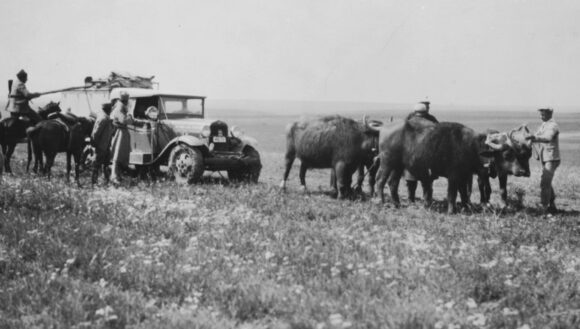
The “Diabolical” pulled from the mud by oxen, Turkey, 1933. Olga Tufnell archive, Palestine Exploration Fund. Courtesy of the Palestine Exploration Fund.
Violence and tragedy
This era of biblical archaeology is often idealized, however, the social and political challenges and tensions at play in Palestine must not be forgotten. There were significant disruptions from the time of the Arab Revolt in the late 1930s, which directly impacted the ability of team members of the Tell ed-Duweir expedition to travel freely. It was a hazardous, disruptive, and tense period. Insecurity in Palestine in the late 1930s was to have devastating consequences to the Tell ed-Duwier expedition, culminating in the tragic murder of expedition director James L. Starkey in January 1938 by ‘Arab brigands,’ bringing to a close Olga Tufnell’s ‘Perfect Journey.’ Her letters from this time reflect naiviety in the run up to the murder, as well as the shock and grief after it had happened.

Olga Tufnell with James Leslie Starkey and the ‘Lachish ewer’ (on table), one of the most important finds from Tell ed-Duweir with its “proto-Canaanite” script dated to the Late Bronze Age (13th century BCE). Photograph: Starkey family collection. Courtesy of Wendy Slaninka.
Women in archaeology: Tufnell’s contribution
Olga Tufnell’s contribution to the recognition of women archaeologists can be seen in her publications including the volumes Lachish III (Iron Age) and IV (Bronze Age) and her later work on scarab seals, which confirmed her scholarly status. In the first half of the twentieth century, if even permitted to be part of an archaeological expedition, many women were illustrators or registrars – extremely important roles, but ones placing them in the background with limited recognition. Through her experiences as a core member of an archaeological expedition in the Middle East, Tufnell proved herself to be as responsible and productive as her male counterparts, if not more so.
While Tufnell did not reach the notoriety of women archaeologists such as Kathleen Kenyon, she proved through hard work that formal academic qualifications were not a necessity. The letters trace her development from novice to experienced archaeologist. While she never took a degree or had a formal academic post, her advice was frequently sought by students and established researchers. Her election as a Fellow of the Society of Antiquaries was the culmination of her achievements, her name adding to a growing list of established women archaeologists. Through this book featuring Olga Tufnell’s archive, we hope that more awareness can be raised of her contributions to archaeology, while providing new sources on the people and places she encountered.
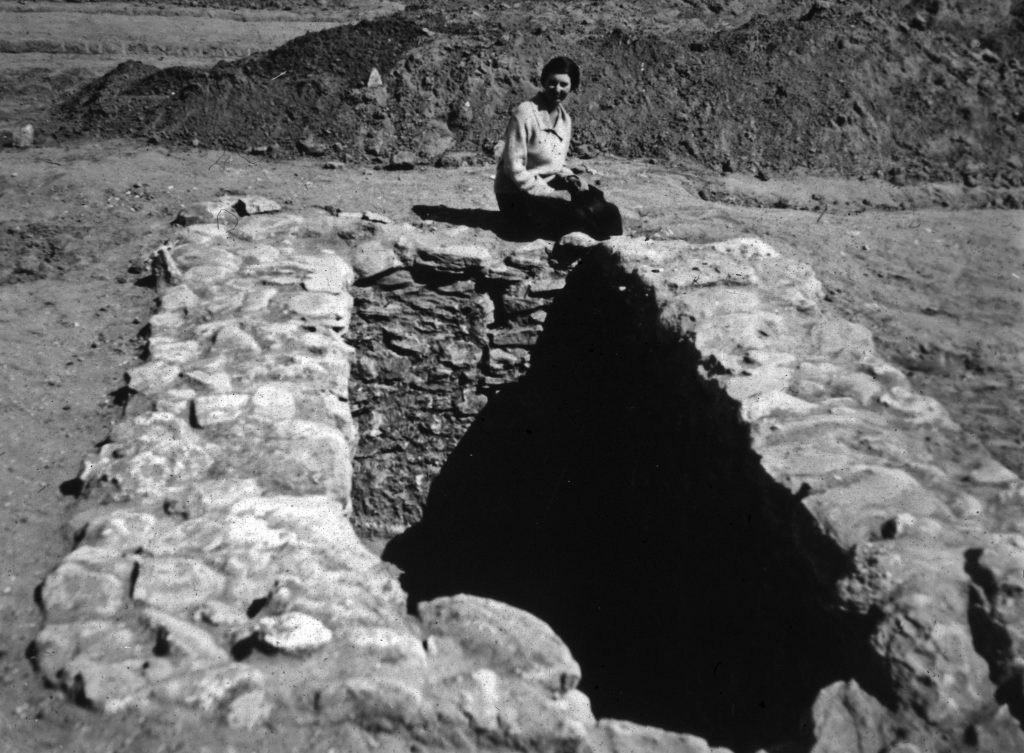
Olga Tufnell and the early Iron Age tomb she excavated at Tell Fara, and subsequently published. Probably Tomb 201, 200 cemetery. Starkey family collection. Courtesy of Wendy Slaninka.
The book presents Tufnell’s experiences chronologically through her letters and many photographs, starting in 1927 and ending in 1938. Our introduction places her in context through themes such as class and gender, colonial viewpoints, archaeology, and travel and tourism. The letters start with Tufnell’s journey from England to Egypt late in 1927, where she participated in a season of recording of tomb paintings at Qau in Middle Egypt, where Flinders Petrie had conducted excavations. The letters from this time are particularly vivid in terms of her descriptions of people, places, nature, and events. Tufnell then joined excavations at the site of Tell Fara in southern Palestine until 1929 (now known as Tell el-Far‘ah (South), in modern Israel) for two seasons. This was one of the major excavations carried out by Flinders Petrie at that time. The following chapter covers a period in 1929 to 1930 while she was based at the Cyprus Museum in Nicosia, providing insights into colonial life and local traditions on the island. From 1930 to 1932, Tufnell returned to Palestine to participate in Petrie’s excavations at Tell el-‘Ajjul (in today’s Gaza Strip). The following chapters cover her time at Tell ed-Duweir (Tel Lachish, modern Israel) between 1932‒1938. This period includes an eventful overland trip by car from Palestine to Europe via Lebanon, Syria, and Turkey. Lastly, an epilogue summarizes Tufnell’s life and work after 1938 until her death in 1985.
This book is a useful resource for those studying the history of archaeology in the Eastern Mediterranean for Palestine, Cyprus, and Egypt. For Palestine, where she spent most of her time, this was groundbreaking period for archaeology. “Hyksos”-era equid burials were being discovered at Tell el-‘Ajjul, and presumed “Solomonic” levels were being unearthed at Megiddo. Added to this, the “Lachish Letters,” were discovered at Tell ed-Duweir in 1935. These inscribed sherds dated to the early 6th century BCE provide glimpses into the kingdom of Judah on the verge of destruction by the Babylonians and offer parallels with passages in the Hebrew Bible.
Tufnell’s lively style makes this a fascinating personal account of dig life and travel in the interwar era. During the course of our writing and editing, while seeking out archaeological insights, we considered the kinds of personal information the letters might contain. They provide background information and subjective viewpoints, expressing opinions of people, places, and events that would not typically be found in an archaeological report. In short, they provide a much-needed real life contemporary perspective often absent in memoirs or biographies.

Olga Tufnell’s “Perfect Journey”: Letters and Photographs of an Archaeologist in the Levant and Mediterranean, is co-edited and introduced by John D.M. Green and Ros Henry, and published by UCL Press (Open Access).
Special guest post by John D.M. Green and Ros Henry




I commend Green & Henry for publishing this fascinating collection of Ms. Tufnell’s letters. Armchair archeologists around the world will benefit from her firsthand accounts of 20th-century excavations. I was particularly interested in her report of the first 40 royal jar-handles found at Duweir/Lachish (p. 227), which the authors insightfully recognized as providing “an important chronological horizon” for Judahite pottery.