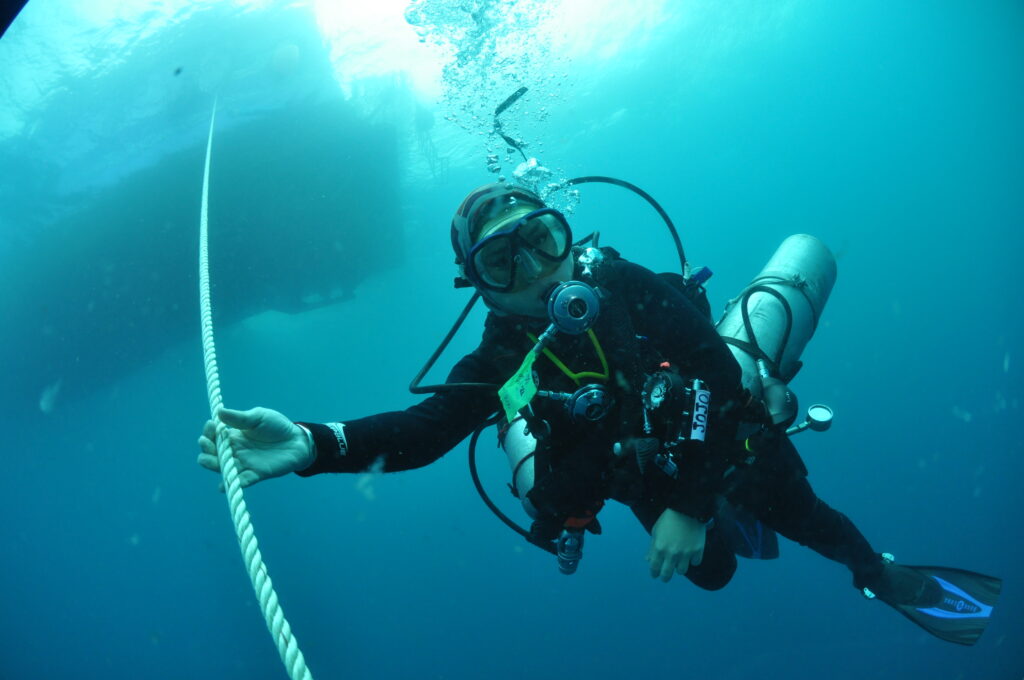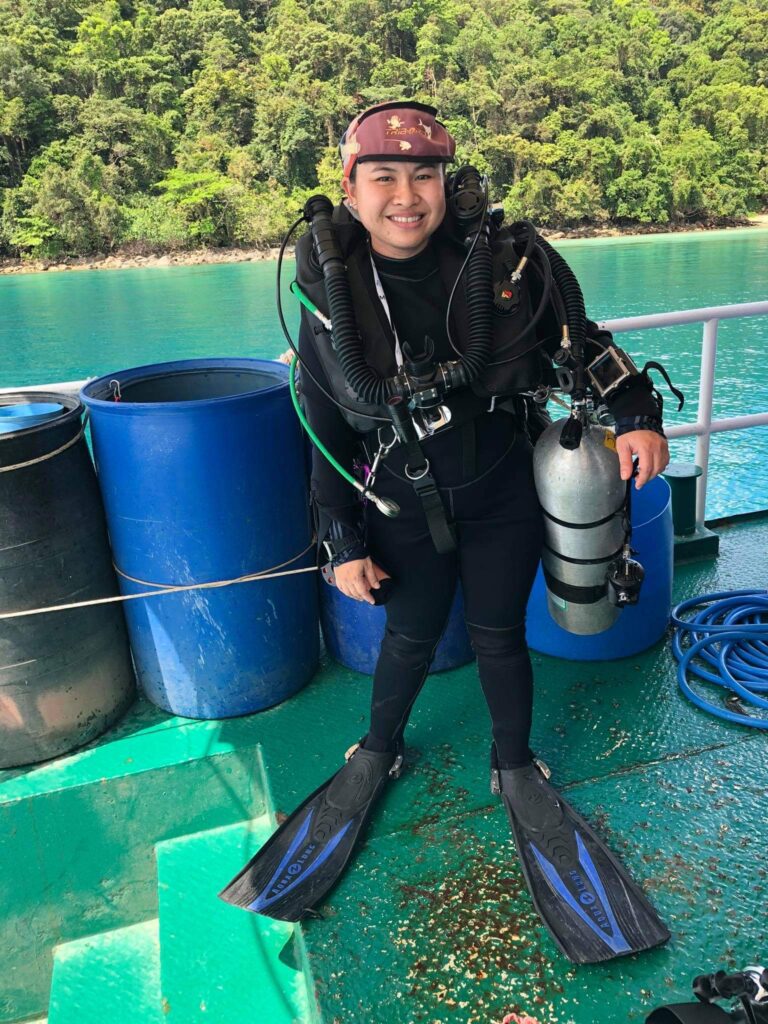
Pornnatcha “Jo” Sankhaprasit made history by becoming Thailand’s first female underwater archaeologist.
As a child, she was raised in the highland mountains of Thailand where she soon became interested in the deep, blue ocean beyond. At the age of 20, she began her first drive. She was fueled by her curiosity and her love of solving mysteries and interest in history, extending beyond being inspired by watching Lara Croft’s discovering magical ruins. She is the first woman in Thailand to become a Marine Archaeologist, graduating with a bachelor’s degree in archaeology from Silpakorn University, Bangkok.
Marine Archaeology is a field that requires patience, diligence, and practice. Each trip to an excavation site can take up to a week or even a month, where the divers are in the water for 30 minutes with a resting period every 3 minutes to relieve pressure before resuming descending. Between each required dive, there is a 2-hour grace period for divers to rest since the average depth reached is between 30-60m. It should be noted that this occupation is extremely risky as the archaeologist could die due to rapid pressure change or to empty air cylinders.
Jo’s most recent mission and the biggest dive of her career happened on March 8, 2018. Deep beneath the Gulf of Thailand, she discovered a ship dating from between 1350 to 1450, during the Khmer Empire, where Sukhothai traders, Ming Chinese treasure hunters and Japanese privateers crossed the seas in search of treasures and trades. The team with Jo believes that the ship once transported pottery, wood, ivory tusks, duck eggs in jars, and spices in containers that may still be intact on the ocean floor.
The day of the dive began at 8am where the team sets course on their boat out to the water in preparation. By 11am, the entire crew gathered for a briefing with the expedition lead inside the ship’s cabin, where they decide what to bring from the shipwreck to the surface and what items to leave behind. All items were considered, while bearing in mind risks such as disintegration upon surfacing, weight, and the danger items may pose as they break apart, causing dust to cloud the already turbid water. By noon, she and her team began gearing up for the dive with tanks strapped on their back.
Jo notes the importance of communication when one submerges into the deep blue water: “you need to write down even the simplest instructions, like moving an artifact to another location, so that you don’t forget”. The crew knows that on the ocean floor, the ship isn’t fully intact; it’s in ruins with wood pieces scattered randomly. By 1pm, Jo resurfaces and communicates her findings and hands over the pieces to her team. When she disrobe her gear, the ship’s cook fries up omelets, pork, and vegetables to fill the archaeologists’ and historians’ bellies.
Today, she continues to serve as inspiration for women and archaeologists around the world by continuing her contributions in marine archaeology. She says, “I never think ‘if men can do it, then so can I.’ I think that I will do the best that I can.”
Guest post by Daosiri Rattanamansuang.
Images courtesy Jo Sankhaprasit and used with permission.
References and further reading:
https://www.khaosodenglish.com/news/2018/03/08/go-deep-thailands-1st-female-undersea-relic-hunter/