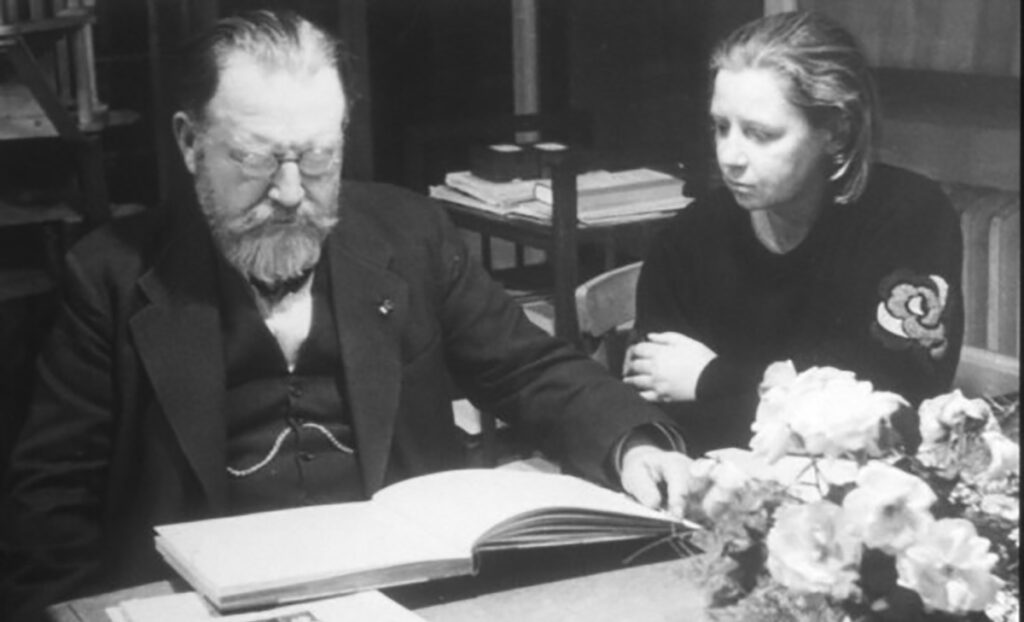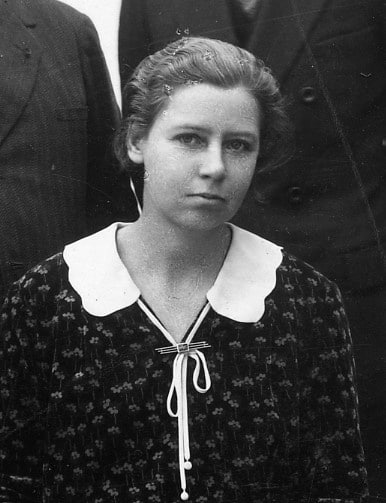
While Marcelle Werbrouck was certainly not hailed as the most renowned scientist of her generation, she deserves to be remembered as the first Belgian woman Egyptologist. In the shadow of Jean Capart, the founder of Belgian Egyptology, she contributed to the discipline’s emergence in Belgium for over 25 years as his main collaborator and his muse.
She was born on 23 May 1889 in Antwerp, the second largest city in Belgium. She was the daughter of Auguste Werbrouck, a general in the Belgian Army who surrendered the city to the Germans in 1914. In 1910, Marcelle Werbrouck obtained a primary school teacher’s degree and a degree as a middle school Regent, supplementing it with a degree as a gymnastics teacher in 1911. When the First World War broke out in 1914, she went into exile with her family in Paris and obtained a diploma as an ambulance driver from the French Red Cross. From 1916 to 1918, she worked as a volunteer nurse at the Hôpital des Jeunes Aveugles and at the Institut Pasteur. Fascinated by ancient civilizations, she also attended courses at the Sorbonne, the Collège de France, the École du Louvre and the École Pratique des Hautes Études de Paris. Her professors included the Egyptologists Gaston Maspero and Georges Bénédite, as well as the Assyriologist Charles Fossey.

Marcelle Werbrouck, Les pleureuses dans l’Egypte ancienne. Brussels: Edition de la Fondation égyptologique reine Elisabeth, 1938.
After the Armistice, Marcelle Werbrouck returned to Belgium. She then began a career as a teacher of History and Art History in Antwerp. At the same time, she took courses at the Société des Cours d’Art et d’Archéologie de Bruxelles (the current Institut Supérieur d’Histoire de l’Art et d’Archéologie) with the Egyptologist Jean Capart, curator of the Musées Royaux du Cinquantenaire de Bruxelles (the current Art & History Museum). Her meeting with Capart marks the great turning point in her life and career. From the early 1920s, she joined the scientific staff of the Cinquantenaire Museum and assisted Capart in the daily management of the Egyptian section and the preparation of its publications on Egyptian art. In 1922-1923, she obtained her degree in Art History and Archaeology with a thesis on the place of statues in the tombs of the Old Kingdom. Then, preparing a doctoral thesis on the theme of the professional mourners in Ancient Egypt, she left for Luxor to study the paintings of the Theban Necropolis. She defended her doctoral thesis in 1925, but did not publish it until 1938 under the title Les Pleureuses dans l’Égypte Ancienne.
She would go on to co-author several major works with Capart. First, in 1926, there is Thèbes. La Gloire d’un Grand Passé, which was published in simplified form for schools as Thèbes. La Gloire d’un Grand Passé expliquée aux enfants. These two books were translated into English under the titles Thebes. The Glory of the Great Past and Thebes. The Glory of a Great Past. A Little Book for Everybody. Then, in 1930, there was Memphis. À l’Ombre des Pyramides. In 1929, she published La Tombe de Nakht and, in 1934, an Album of the Egyptian Department. In 1943, she took part in the reworking of Capart’s best-seller Tutankhamun. Finally, in 1949, she published Le Temple d’Hatschepsout à Deir el-Bahari; an homage of a woman to another woman. Her bibliography also includes more than 150 articles, reviews, etc., many of which appeared in the journal Chronique d’Égypte or in the Bulletin des Musées Royaux d’Art et d’Histoire in Brussels. The history of women in Ancient Egypt was a persistent theme throughout her life and work.
A woman of letters, Werbrouck was also a woman of teaching. From the second half of the 1920s, she taught part of the courses given by Capart in several Belgian universities, notably the Institut des Hautes Études de Belgique, the École Supérieure de Jeunes Filles de Bruxelles and the Institut Supérieur d’Histoire de l’Art et d’Archéologie de Bruxelles. Throughout her career, she also gave numerous lectures during the countless trips she made around the world.
In 1923, Marcelle Werbrouck joined the Fondation Égyptologique Reine Élisabeth created by Jean Capart to promote Egyptology in Belgium. She rose through the ranks: from assistant secretary (1923), to secretary (1925), to editorial secretary of the journal Chronique d’Égypte (1932), then assistant director and head of the Pharaonic section (1933) and, last but not least, director (1947). From 1925, she also directed the Egyptian section of the Cinquantenaire Museum, where she succeeded Capart, who had just been appointed chief curator. Although Capart maintained an interest in operations, this position allowed her to maintain some control over policy. The tireless work of the Capart-Werbrouck duo led to the golden age of Belgian Egyptology from the second half of the 1920s to the Second World War. During this brief period, Brussels was considered by many as the capital of Egyptology and papyrology. Several major international meetings were organized there by the Foundation from 1930 onwards.
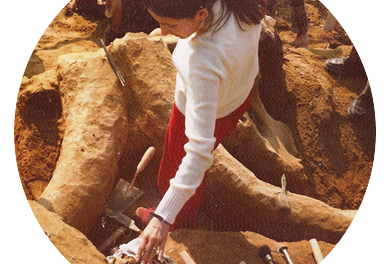
Among the purposes of the Fondation Égyptologique Reine Élisabeth was the organization of excavations in Egypt. In 1924, Marcelle Werbrouck led a first mission to the region of Sheikh Fadl (Middle Egypt) in search of a necropolis that she would never discover. This made her the first Belgian woman to have conducted archaeological excavations in Egypt. Three years later, she excavated with Capart at Hu (Diospolis Parva). Together, they unearthed a small chapel dedicated to the god Thoth, as well as a large number of jars containing mummies of ibis birds. In the absence of Capart, who was based in the US in 1936, she began negotiations with the American artist and patron Marius de Zayas and the Director General of the Egyptian Antiquities Service, the Frenchman Étienne Drioton, which led to the concession to Belgium of a major site: Elkab (Nekheb or Eileithyiaspolis). Werbrouck’s role in organising the excavations at Elkab is of prime importance, but it was also the source of a lively controversy between Belgians and Egyptians. Indeed, when Capart announced to the Egyptian government’s Egyptology Committee his intention to appoint Werbrouck as co-director of the excavations, the members of this Committee protested. They would never accept that a woman should be able to manage an archaeological site in a Muslim country.
Furious, Capart was forced to return so that Werbrouck could officially continue to work with him at Elkab as an excavator. In only three campaigns (1937, 1938 and 1945-1946), their discoveries demonstrated the importance of Elkab in the history of Upper Egypt, as well as the importance of the sacred domain of the goddess vulture Nekhbet, which was as vast as that of the god Amon at Karnak. In particular, Werbrouck contributed to making Nekhbet’s iconography known.
The campaign of 1945-1946 ended abruptly in Cairo on the night of 21 February 1946. A violent fire had ravaged part of the Cinquantenaire Museum the day before, and anti-colonialist rioters set fire to Capart and Werbrouck’s hotel that evening. They fled via the rooftops and emerged unscathed, but Werbrouck lost the manuscript of a book she had just finished writing in the flames. A few days later, on their way to Tanis, their car went off the road, plunging into an irrigation canal. These successive turns of fate were interpreted by some as a manifestation of the “Curse of Tutankhamun” and incited them to flee Egypt. (In 1923 Capart had participated, alongside Queen Elisabeth of Belgium, in the opening of the funeral chamber of the Pharaoh Tutankhamun. As for Marcelle Werbrouck, in 1924, she was one of the first women in the world to be able to admire in situ the golden sarcophagus of the Pharaoh, shortly after its discovery by Howard Carter.)
When Jean Capart died in June 1947, Marcelle Werbrouck became director of the Fondation Égyptologique Reine Élisabeth, a position she held alongside her appointment as curator of the Egyptian section of the Royal Museums of Art and History in Brussels. All her efforts were aimed at raising up the Egyptian section that was damaged by the fire of 1946 and at preserving Capart’s scientific heritage.
Outside of Egyptology, Marcelle Werbrouck was a fervent Catholic who remained single throughout her life. She was portrayed by her entourage as a feminist who was interested in the place of women in 20th century society. In the inter-war period, at the instigation of her friend the French Egyptologist Marcelle Baud, she joined the Soroptimist movement, a women’s service club with international ramifications. She even took part in the creation of the Soroptimist Club of Brussels, of which she became the first president in 1938.
Her last years were marked by illness and by the gradual abandonment of her duties to the Belgian Egyptologist Pierre Gilbert: in 1954, having reached the age limit, she retired as curator of the Egyptian Department of the Cinquantenaire Museum. In 1958, she resigned as director of the Fondation Égyptologique Reine Élisabeth and retired for good.
It was during her holidays in Mailhat in the French Auvergne, near Marcelle Baud, that the first Belgian woman Egyptologist died on 1 August 1959 at the age of 70.
By Jean-Michel Bruffaerts, Researcher – “Pyramids and Progress” (EOS – FNRS/FWB) and Director of the Jean Capart Fund. Images provided by the Association Égyptologique Reine Élisabeth (AERE) and used with permission.
Sources:
- Bruffaerts Jean-Michel, 2018, Marcelle Werbrouck ou l’égyptologie belge au féminin, in Florence Doyen – René Preys – Arnaud Quertinmont (eds.), Sur le chemin du “Mouseion” d’Alexandrie. Études offertes à Marie-Cécile Bruwier, Montpellier, Université Paul Valéry Montpellier 3, 43-71 (Cahiers de l’ENiM).
- Bruffaerts Jean-Michel, 2013, Bruxelles, capitale de l’égyptologie. Le rêve de Jean Capart (1877-1947), in Suzanne Bickel – Hans-Werner Fischer-Elfert – Antonio Loprieno – Sebastian Richter (eds.), Ägyptologen und Ägyptologien zwischen Kaiserreich und Gründung der Beiden Deutschen Staaten. Reflexionen zur Geschichte und Episteme eines altertumswissenschaftlichen Fachs im 150. Jahr der Zeitschrift für Ägyptische Sprache und Altertumskunde, Berlin, Akademie Verlag – De Gruyter, 193-241. (Zeitschrift für Ägyptische Sprache und Altertumskunde. Beihefte, 1).
- Brunner Hellmut, 1959-1960, Marcelle Werbrouck (23. Mai 1889 bis 1. August 1959), in Archiv für Orientforschung (Wien), 19, p. 260.
- Capart Jean – Werbrouck Marcelle, 1926, Thebes. The Glory of a Great Past. New York, Lincoln Mac Veagh, The Dial Press, 362 p.
- Capart Jean – Werbrouck Marcelle, 1930, À l’Ombre des Pyramides, Bruxelles, Vromant & C°, XVIII-415 p.
- Capart Jean, 1943, Tout-Ankh-Amon, Bruxelles, Vromant S.A., 211 p. Avec la collaboration de Marcelle Werbrouck, Éléonore Bille-De Mot, Jeanne-M. Taupin, Pierre Gilbert.
- Gilbert Pierre, 1959, Marcelle Werbrouck. Anvers 23 mai 1889 – Issoire 1er août 1959, in Chronique d’Égypte (Bruxelles), XXXIV, 34, p. 187-202.
- Gilbert Pierre, 1960, Rapport du directeur, in Chronique d’Égypte, XXXV, 35, p. 5-9.
- Marcquebreucq René, 1959, Marcelle Werbrouck (1889-1959). Bibliographie, in Chronique d’Egypte (Bruxelles), XXXIV, p. 192-202.
- Werbrouck Marcelle, 1926, The Glory of a Great Past. A Little Book for Everybody. London, G. Allen & Unwin Ltd, 48 p.
- Werbrouck Marcelle – van de Walle Baudouin, 1929, La tombe de Nakht. Notice sommaire. (Musées royaux d’Art et d’Histoire, Bruxelles). Bruxelles, Éditions de la Fondation Égyptologique Reine Élisabeth, 23 p.
- Werbrouck Marcelle, 1934, Musées royaux d’Art et d’Histoire, Bruxelles. Département égyptien. Album. Bruxelles, Éditions de la Fondation Égyptologique Reine Élisabeth, VIII p., 100 pl.
- Werbrouck Marcelle, 1938, Les Pleureuses dans l’Égypte ancienne. Bruxelles, Éditions de la Fondation Égyptologique Reine Élisabeth, 178 p.
- Werbrouck Marcelle, 1949, Le Temple d’Hatshepsout à Deir el Bahari. Bruxelles, Éditions de la Fondation Égyptologique Reine Élisabeth, 139 p.