Dr. Tomoko Nagatomo is a leading archaeologist in Japan who specialises in Neolithic pottery. Her detailed research on the development of complex societies in relation to the invention of pottery kilns has gained recognition not only in Japan but in South Korea.

Image courtesy Saigen Jiro CC0 1.0 Universal
The focus of her studies is the Yayoi pottery, a style of pottery associated with the Yayoi period, or the Japanese Neolithic (around 10th century BCE – 3rd century BCE). Although Yayoi pottery has long been a popular topic of archaeological research, not much is known about its production – who made them, where they were made, and how the technique was first transmitted to Japan. This is partly due to the fact that Yayoi pottery was made in open fires, which do not leave as much of an archaeological footprint as kiln structures. In the early 2010s, she set out to unravel the social structure around Yayoi pottery production.
Nagatomo focused her research on the regional discrepancy in the pottery typology, and the changes in the diet and cooking technologies. Her research revealed the heavy involvement of the upper classes in the management of Yayoi pottery production. Previously, archaeologists had hypothesised that pottery was locally produced on a small scale. However, Nagatomo revealed that pottery production was much more centralised, and on a much larger scale. In fact, Nagatomo argues that the development of a centralised production system played a role in the birth of chiefdoms and large scale pottery production using kilns in the later periods.
Her research now forms a key part of the story of social stratification, development of pottery production, and economic specialisation in the Japanese Neolithic. In 2015, her book “The Development of Pottery Production in the Yayoi Period” won the Japanese Archaeological Association Encouragement Award.

Image courtesy Saigen Jiro CC0 1.0 Universal
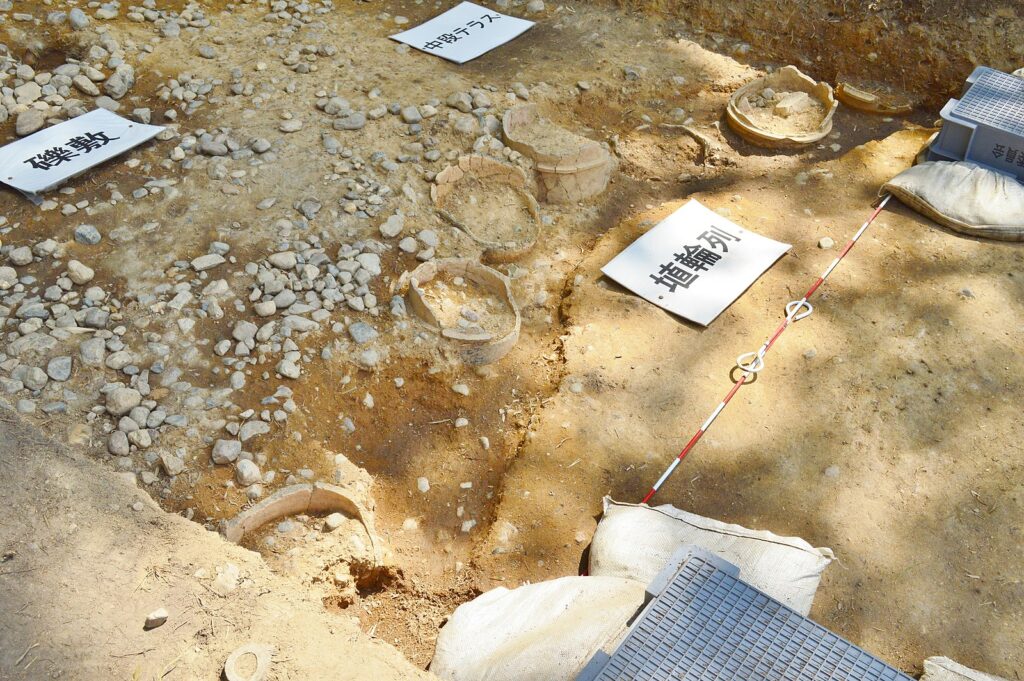
Nagatomo is currently conducting further research into the introduction of pottery kilns in Japan, including the excavation of Kutsugawa Kurumazuka Tumulus. The Kutsugawa Tumuli is known to contain kiln-produced pottery, and this study is believed to reveal more about the early kiln-fired pottery producing communities in Joyo, Kyoto.
Nagatomo was born in Kyoto in 1972. She received her doctorate in Culture Formation Studies from Osaka University in 2005. She is currently a professor at Ritsumeikan University as well as a member of the Council for Protection of Cultural Properties in Yao, Osaka, and Joyo, Kyoto.
Guest post by Mayuka Saegusa as part of the 2021 UCL TrowelBlazers Digital Fieldwork Project.
References:
Ritsumeikan University 2021 Researcher Database: NAGATOMO Tomoko. Accessed 29 July. https://research-db.ritsumei.ac.jp/rithp/k03/resid/S000942#880
Nagatomo T. 2013 The Development of Pottery Production in the Yayoi Period. Rokuichi-Shobou, Tokyo
(和訳)
長友朋子は日本の考古学者。日本の新石器時代である弥生時代の土器を専門に研究する。土器を生成する釜の分布と社会構造の複雑化の関連性を扱った研究は日本だけなく韓国でも注目されている。
日本の新石器時代とも言われる弥生時代(紀元前10世紀ー3世紀)の土器に焦点を当てた研究を行っている。弥生土器に関する研究は以前から盛んだったものの、製作者、出産地、どのようにして技術が日本に伝えられたかなど、生産については未だ明らかになっていない部分が多い。これは、弥生土器が生産にはまだ釜が使われていなかったため、考古資料が乏しいことも原因とされる。2010年代前半に、弥生土器の生産に関わる社会構造を明らかにするべく研究に乗り出した。
地域的な土器の差異や、食生活と調理方法の変化などに注目し、研究を行った。結果、弥生土器の生産の管理には、上位階層が深く関わっていたことが判明した。従来、弥生土器の生産は小規模なものだと考えられてきたが、上位階層により生産拠点が集約され、比較的大規模な生産もされていたことが判明した。また、そのような生産拠点の集約は、のちの古墳時代における上位階層による釜の戦略的な配置に繋がったことが提唱された。
これらの研究成果は、現在、日本の新石器時代における社会の階層化と専業化の歴史を考察する上で非常に重要なものとなっている。2015年、著書「 弥生時代土器生産の展開」は日本考古学協会奨励賞を取得した。
現在は、日本における釜の導入について更なる研究を進めている。その一環で、久津川車塚古墳の発掘に携わっている。久津川古墳群は釜で生成された土器を含んでいることがわかっているため、京都城陽市における、釜を用いた土器生産社会についての理解を深めるのに役立つと思われる。
1972年京都生まれ。大阪大学文学研究科文化形態論にて2005年に博士号を取得している。現在は立命館大学の教授を務めると同時に、大阪府八尾市や京都府城陽市の文化財保護審議会の委員を務めるなどしている。