
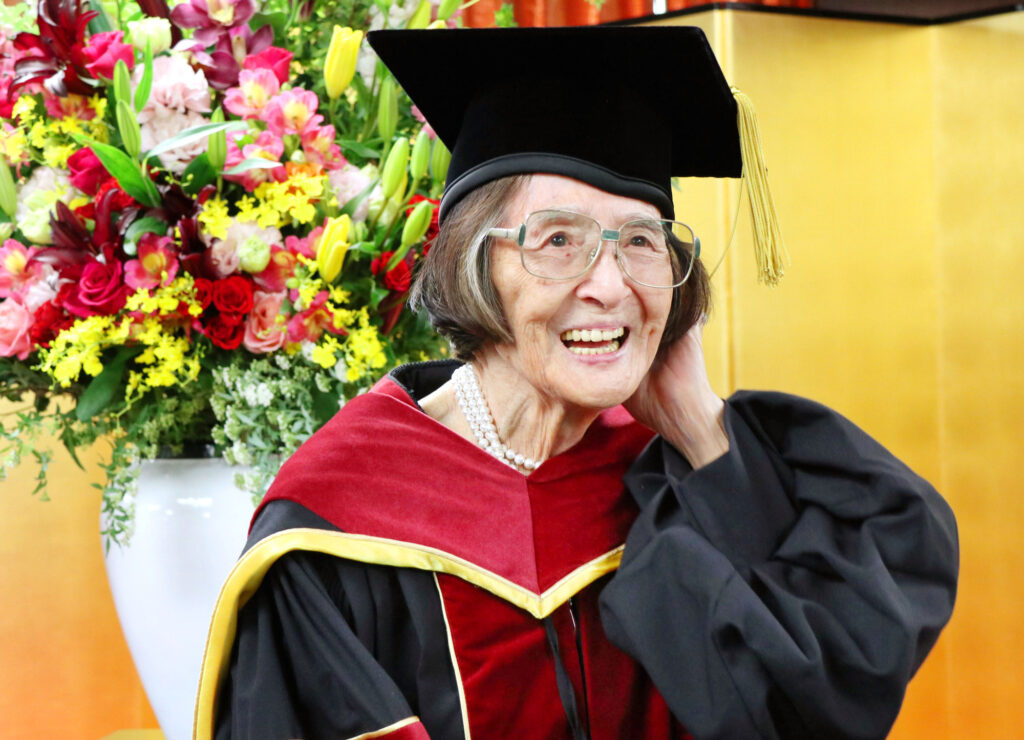
Dr. Kiyoko Ozeki is a Japanese archaeologist who focuses on clothes and textiles in the Jomon period, the Japanese Mesolithic (around 15th century BCE – 10th century BCE).
Born in 1929, Ozeki graduated from high school in Aichi Prefecture, Japan. As it was rare for women at the time to receive higher education, she did not proceed to university and instead started working in a bank. While working as a bank officer, she continued her hobby: crafts. She later quit her job to run her own crafts class as well as exhibitions.
Her craft works received recognition and in 1964, she was offered the position of a crafts course lecturer in Tokaigakuen Women’s Junior College. She was later promoted to assistant professor and started conducting research in cultural history.

Image courtesy Chris 73 CC BY – SA 3.0
Her archaeological career started in 1987 when she encountered “angin”, a Jomon period textile believed to be used for imprinting the pattern on Jomon pottery. (Jomon in Japanese means something along the lines of “rope pattern” – named after the decoration on characteristic pottery from this period.) She investigated the patterns left on surviving Jomon pottery and reproducing the angin cloth with contemporary technology. Thus, she became a pioneer in Jomon experimental archaeology. However, she did not stop here. She made clothes out of angin cloth, and lived in a Jomon-style pit house to explore the possibility, in the Jomon climate, to wear clothes made out of textiles instead of leather. Her experimental research was extremely controversial, not only because of its extreme methods but because it was widely believed that cloth weaving technology only developed in the later Yayoi period. Ozeki proved that the cloth was first invented in the Jomon period, and transformed the widespread image of Jomon fashion.

Image courtesy Soseki no Neko CC BY – SA 4.0
She summarised her 30-year-old research in a book, which was published in 2012 and earned wide acclaim. Although she had never received a bachelor or a master degree, she was invited as a visiting research student by Ritsumeikan University in Kyoto. From 2015, she worked on her PhD thesis which was completed and published in 2018 by the same university. This work earned her a doctorate, and she became the oldest woman in Japan to receive a doctorate, at age 88.
She is now an emeritus professor at Tokaigakuen University. She also continues to run experimental archaeology workshops on Jomon cloth.
Guest post by Mayuka Saegusa as part of the 2021 UCL TrowelBlazers Digital Fieldwork Project.
(和訳)
尾関清子は日本の考古学者。日本の中石器時代である、縄文時代(紀元前15000〜10000)の布や衣服を中心に研究している。
1929年生まれ。愛知県の高校を卒業。当時は女性の大学進学はあまり普遍的ではなかったため、進学せずに銀行員などとして働き始めた。銀行員をするかたわら、趣味の手芸を続けた。のちに仕事を辞め、手芸教室を始め、作品展も開催した。
手芸が評価され、1964年に東海学園女子短大に、手芸講師として勤めることになる。のちに助教授となり、文化史の研究を行った。
1987年、編布(アンギン)と呼ばれる、縄文時代に土器の模様をつけるために使用されたといわれる布に出会ったことで、考古学の道を進ことになる。縄文土器を研究し、残っている縄目の模様から、当時の技術を使って編布を再現する。縄文時代の布に関する実験考古学(考古資料の用途などを研究する上で、実験的手法を用いること)のパイオニアとなる。編布の再現にとどまらず、編布を用いた洋服を作り、縄文時代の住居を再現した竪穴住居で暮らしてみるなどした。結果、これまで縄文時代の衣服は革製だと考えられてきたが、布製であった可能性を提示した。この研究は、手法が画期的だったことのみならず、日本最古の布は弥生時代のものだったという当時の考えを覆した。縄文時代には布は作成されていたことを証明し、縄文時代のファッションに対するイメージを大きく変えることとなった。
2012年、30年間にもわたる研究を、著書「縄文の布 日本列島布文化の起源と特質」にて出版。この研究が評判となり、学士、修士号を持っていなかったにもかかわらず、立命館大学に客員協力研究員として迎えられる。2018年、それまでの研究成果をまとめた博士論文が完成し、立命館大学より博士号を授けられる。現在、日本での博士号取得にて最高齢の女性としての記録を所持する。
現在は、東海学園大学の名誉教授である。また、縄文時代の布に関する実験考古学のワークショップを開催するなど、研究活動も続けている。
Reference:
The Sankei News 2018. “88-year-old Kiyoko Ozeki, research on Jomon cloth, the oldest person in Japan to receive a doctorate, ceremony at Ritsumeikan University”. Accessed 29 July 2021. https://www.sankei.com/article/20180324-SPC2QZMN2JJVPBS5GPI5FSOALY/photo/7MFQG726DBJYLNN25NVS7GP7MA/


