Gussie white was one of the many African American women working on the Irene Mound project in 1937 under the Works Progress Administration. Out of all the women working on the mound, all 32 white women have been named but barely any of the African American women working were recognised for their efforts. We aren’t even sure exactly how many of them there were! It was also exceptionally difficult to track down any images of her specifically. I wanted to share Gussie’s experience because she, like many of her other colleagues, had been denied the recognition they deserve for their work. She was also one of the few amongst the handful of women whose names are known to us. The majority of the others are unknown.
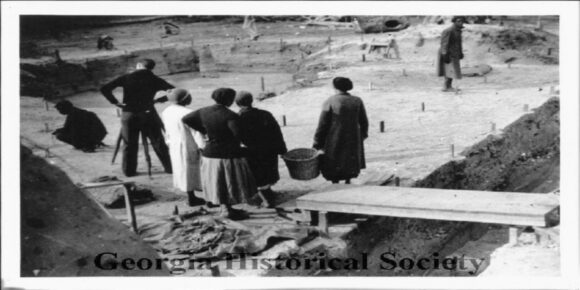
Arfrican American women working on Irene Mound – images courtesy of the Georgia Historical Society Archives
Gussie attended the Tuskeegee Normal School for Women and had training as an educator and clerical worker before the excavation. She looked for work on the project after her husband was disabled after a workplace accident, this was a common trend with the other Irene mound workers, many of them were working because their husbands were temporarily out of work at the time. Her employment was under the Works Progress Administration which was part of Roosevelt’s New Deal; aiming to combat unemployment after the Wall Street crash. At the time of her employment, Gussie also had a 14-year-old son, John White, who she was looking after. Luckily for us, he was interviewed by Gail Whalen and because of this, we know a lot more about him and his mother. John later went on to become one of Savannah’s “original 9” – the first 9 Black police officers in Savannah and was the first black police officer in Savannah. Amazing!
John recalls that his mother would wake up at 5 am every morning, cook her family breakfast and then leave to catch a truck to the site. He also remembered that she wore gloves, the boots she used when milking the cows (also referred to as brogans), and a cotton dress. The WPA didn’t provide the workers with much equipment and many women, like Gussie, just went to work in what they had available. John also fondly remembers occasionally ride his bike up to the mound to see what his mother was doing at work.
Unfortunately, despite her work, Gussie and many other African American women were paid little, and in most cases, less than their white counterparts working on the site. According to John, his mother was paid 12 dollars a week before receiving a 50% pay rise later on. In 1937, when the excavation started, $12 would be equivalent to $213.66 today – let’s assume they had 1 day off the job per week – $213.66 divided by 6=$35.61. Assuming it’s an 8hr working day (probably longer for these women) they would be paid the equivalent of $4.45 per hour today. These calculations are speculation, but I think this still illustrates that the women of Irene mound were paid poorly despite their efforts and were given little to no equipment or facilities on site.
More about Gussie:
It can be assumed that Gussie was able to speak Gullah, an African-American creole language that developed among enslaved Africans on the southeast coast of the USA; John spoke a little in his interview with Gail and also mentioned that another of the women working on the site, Mattie Smith, also spoke Gullah. The Gullah are African American communities living in areas of the US states of Georgia, Florida and South Carolina. Both the culture and the language have strong African roots and form an important part of African-American heritage. Gullah is still spoken by over 5,000 people in coastal South Carolina and Georgia today.
I hope by writing this article I can share Gussie’s contribution, and include her within archaeology’s historical narrative. She sounded like a wonderful and hardworking woman and I hope that we can give her the proper recognition she deserves. I also hope that in the near future, either myself or others, whether they be in the academic community or not, can find more information on her and the other African American women from the Irene Mound project so that their contributions can be properly appreciated. They did do most of the heavy lifting after all!
More Info!
A short essay by Gail Whalen on Irene Mound’s excavation
Intro to The Irene Mound excavation
About John White and his achievements
An oral history interview with John White about Gussie and her work
With many thanks to the Georgia Historical Society for permission to reproduce the images here.
Written by Zara Rashid as part of the TrowelBlazers Digital Fieldwork Project at the Institute of Archaeology, UCL