

Dr. Catherine McCann was an American archaeologist, specialised in Native American and indigenous prehistory. She worked on the Irene Mound Excavations (1938-1940), as an anthropology graduate interested in human ecology. As well as working on the site, she led a diverse archaeological career, spanning from the start of her undergraduate degree in 1926 to her retirement in 1971. Alongside her impressive academic career, she was also devoted to public archaeology, so we can assume she would have been thrilled with the TrowelBlazers initiative!
Catherine McCann was born in Carlyle, Wibaux County, Montana in 1908. Her father, David McCann was a rancher and she had a brother, Dave Jr, and a sister, Vernie. Carlyle is now a ghost town, with a once small agricultural community. Having been brought up in the Great Plains, she would have been exposed to aspects of the rich Native American culture in the region. In 1930, she graduated from the University of Montana with a degree in “Foreign Languages”, specifically Latin and Classical archaeology. Here, she was a keen member of the Women’s Athletic Association, specialising in riflery. Following the completion of her undergraduate degree, she went on to do her MA at the University of Wisconsin, and her PhD at the University of Pennsylvania in anthropology in 1937.
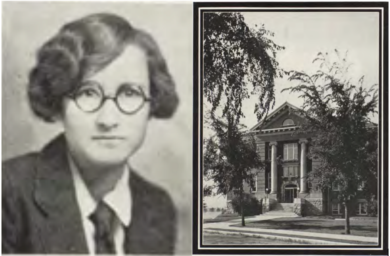
Catherine McCann in her senior year at the University of Montana and the University in 1930.
Image courtesy of the Archives and Special Collections of the Mansfield Library, University of Montana.

Her involvement with the Irene Mound site began in 1938 when Catherine was sent to the Southeast to fill staff positions for the New Deal WPA programme. She was especially interested in human ecology, having studied this at both the University of Wisconsin and the University of Pennsylvania. Her aim was to determine the natural resources available to the indigenous people of the site, and therefore the various environmental pressures that affected their daily lives. This kind of ecological surveying was very new to the USA, and Dr McCann’s work on mapping the environmental features of the Irene Mound region was important in developing further surveying of Georgia. From her time working on Irene, Dr McCann published 3 articles on the site and co-wrote the final report.

Photograph of Dr. McCann excavating on the Bell Philhower site.
Courtesy of the Rochester Museum & Science Center, Rochester NY. ©RMSC 2020
In 1947, Dr. McCann completed her PhD thesis and worked on the Bell Philhower site. In the following years, she was appointed Curator in both the Tioga Point Museum and the Penn Memorial Museum, where she was also a key figure in the creation of the Hall of Anthropology. In 1971, she was a contributor and co-editor of the “Foundations of Pennsylvania Prehistory”, a compilation of the most important investigations into the prehistory of Pennsylvania. Dr McCann retired later that year and was shortly awarded the J. Alden Mason Award from the Society for Pennsylvania Archaeology for her contributions to the field. In 1986, Catherine McCann died in New York due to complications from Multiple Sclerosis, which she had suffered from for many years. Dr. McCann’s legacy, however, is not limited to her academic publications. Throughout her career, she advised and worked with local community archaeology projects such as the ASNJ (Archaeological Society for New Jersey) and the SPA (Society for Pennsylvania Archaeology) and after her retirement, she focused her efforts on publishing SPA projects.
Many thanks to the following institutions and archives for their generous image and information contributions:
The State Museum of Pennsylvania, Pennsylvania Historical and Museum Commission
Archives and Special Collections of the Mansfield Library, University of Montana
Rochester Museum & Science Center, Rochester NY
References and further reading:
http://twipa.blogspot.com/2019/12/notable-women-of-pennsylvania.html
Claassen, C. (1993). BLACK AND WHITE WOMEN AT IRENE MOUND. Southeastern Archaeology, 12(2), 137-147.
William R. Ritchie’s 1949 The Bell-Philhower Site Sussex County New Jersey. Prehistoric Research Series 3(2) published by the Indiana Historical Society.
Written by Juliette Grieve as part of the TrowelBlazers Digital Fieldwork Project at the Institute of Archaeology, UCL.


