Imagine working in a time when constructing communist buildings was more important than preserving archaeological sites, a time when voicing an opinion different from the one of the ruling party could have cost your job or you could have been sent to prison. It was in such a time that Magdalina Stancheva had to work.
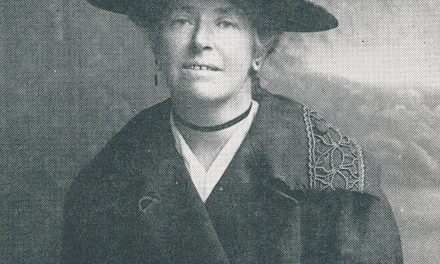
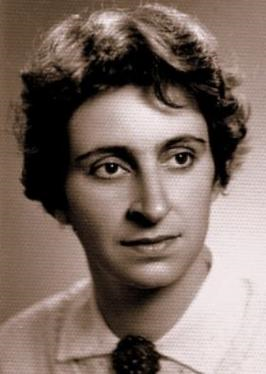
Born 7th of September 1924, she was a Bulgarian classical archaeologist and one of the first museologists in the country. She graduated in 1948 with a degree in classical philology and history.
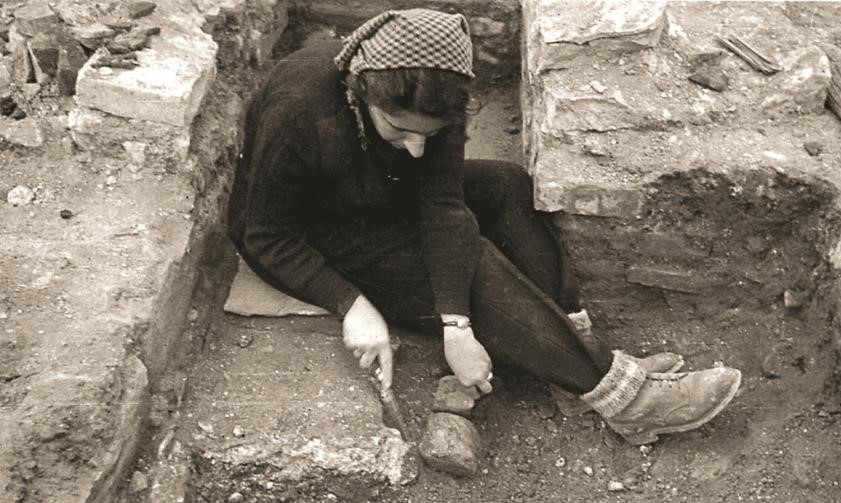
Magdalina Stancheva at one of her sites
She spent most of her life excavating the central part of Sofia, which during the early 50s had to be completely rebuilt, as it did not look sufficiently ‘socialist’. Because of her personal belief that sites must be preserved for the public and not destroyed ,and because she constantly delayed the construction projects of communist buildings, Stancheva was not liked much by the communist regime. In one interview she tells how one day while she was descending into one of her 5 meters deep trench, she was told by the main architect that she will be pushed off the ladder if she continues delaying the construction work.
Despite being warned several times that she might get in trouble, she managed to save from complete destruction two churches- one dating to the 11th century and the other- to the 6th century. She also excavated and preserved the eastern gate of Serdica (the Roman name of Sofia) and two of its towers.

The 6th century church at the time when it was supposed to be destroyed
In the early 70s, Stancheva was appointed as a Bulgarian delegate to the International Council of Museums of Paris and the UNESCO World Cultural Heritage Committee, where she served as vice president for six years.
Throughout her career she strongly believed that if there is no archaeological evidence, theories about people and events cannot be created, an opinion that was not commonly held during the time in which she had to work. She was also convinced that people will always be able to see through propaganda and trust strong archaeological evidence when it comes to the past.
She gave lectures at Sofia University as well as at the National Academy of Arts and at New Bulgarian University, inspiring dozens of archaeologists, both women and men. She was also one of the first archaeologists to write articles about the Ottoman era, a period to which it was not paid much attention too until then.
She has more than 600 publications, including an archaeology book for children. Magdalina Stancheva died on 6th of October 2014, after spending her whole life fighting for the preservation of Sofia’s archaeological heritage.
More about Magdalina Stancheva on http://magdalinastancheva.net/en_biography.php
Images provided by Vesselina Vassileva and used with permission, all rights reserved.
Guest post by Ani Hristonova, submitted as part of the TrowelBlazers Digital Fieldwork Project at the Institute of Archaeology, UCL.