Hetty Goldman was one of the pioneers in the investigation of pre- and early Greek cultures. Born in 1881, she received her B.A. from Bryn Mawr College in 1903, double majoring in English and Greek. After two years of graduate study at Columbia University, she went to Radcliffe University for her Masters in classical languages and archaeology in 1909. She became the first women to hold Harvard’s prestigious Charles Eliot Norton Fellowship in Greek Studies at the American School of Classical Studies in Athens, studying there in 1910-1912.
Her desire to excavate was kindled during her time in Greece and was further fuelled by the many field trips to archaeological sites with the American School. In 1911, Goldman and her colleague, Alice Walker, were granted permission to excavated Halae-by-the-Sea, despite earlier failed attempts and discouraging professors. With the excavations at Halae, Goldman and Walker became the first ever women to direct an excavation in mainland Greece (Harriet Boyd Hawes was the first in Greece). They excavated over 280 graves at Halae which crucially allowed her to establish a reliable chronology for the style of terracotta figures in the area. Returning to the U.S. during the war, she earned her Ph.D. at Radcliffe in 1916.
Following an abrupt end to her excavations at Colophon (where she worked with Lulu Eldridge) due to the outbreak of the Greco-Turkish war in 1922, Goldman moved on to a new site. The site was Eutresis in Boeotia, where she worked with many other women such as Dorothy Burr Thompson, Hazel Dorothy Hansen, Dorothy Hannah Cox, and Barbara McCarthy. The site contributed important evidence for the domestic architecture, pottery, and trade of pre-Mycenaean Bronze Age Greeks.
Goldman’s final and arguably most famous excavation was of Tarsus in Cilicia, in modern-day Turkey. She once again worked with Cox, and with Virginia Grace. Tarsus was a site where many different cultures came together, reflected greatly in the excavations’ finds. Goldman described a “sealed deposit in which there were both Hittite royal seals, a Hittite royal deed and Mycenaean pottery, much of which was imported from the Greek mainland”. The excavations at Tarsus proved to be important in understanding the mutual influence of the different cultures there and how they affected one another.

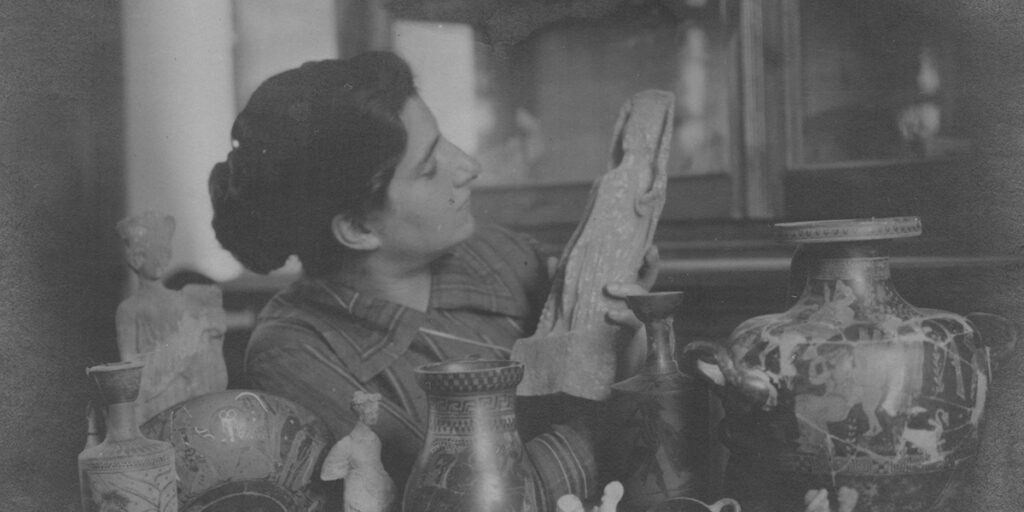
Hetty Goldman examining antiquities in the Museum at Thebes. (Image courtesy Bryn Mawr College Special Collections)
In 1936, Goldman joined the School of Humanistic Studies at Institute for Advanced Study in Princeton, becoming the first woman professor there. She carried on spending time excavating for the next few years, and even though she went back to the U.S. during the second world war, she once again returned to the field in 1947, aged 66, marking her final year of active excavation and retirement.
Goldman and her many associates worked to publishing the results at Tarsus over the next fifteen years, and the three volumes that resulted were a testament to her efficient yet thorough excavation methods, becoming important resources concerning the contacts between the Aegean and the eastern Mediterranean. These monumental publications had a lasting impact on field archaeology and on Greek and Near Eastern history and remains essential to this day.
Hetty Goldman had made significant contributions to the development of archaeology as a discipline. She was awarded the Gold Medal of the American Institute of Archaeology for Distinguished Archaeological Achievement in 1966, being the second person ever to receive the institute’s highest award. With her focus on cross-cultural influences and on the lives of common people, her innovative excavation techniques, her meticulous attention to detail, as well as her thorough publications that served as models for publications to come, Goldman had no doubt a long-lasting legacy, and would be remembered not just as one of the great archaeologists in the first half of the twentieth century, but also for her role in opening the field of archaeology for women.
More information:
https://www.ias.edu/hetty-goldman-life
https://www.ias.edu/goldman-legacy
Cohen, Getzel M.; Joukowsky, Martha Sharp (2006). Breaking Ground: Pioneering Women Archaeologists. University of Michigan Press. pp. 29-350.
With special thanks to the Bryn Mawr College Special Collections.
Guest post by Chung Him To as part of the 2021 UCL TrowelBlazers Digital Fieldwork Project.