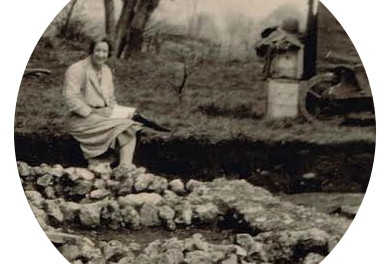
Galina Pugachenkova was born in 1915 in the Imperial Russian outpost of Verniy (now Almaty, Kazakhstan) shortly before the Bolshevik revolution, and spent her life and career working on the architecture and archaeology of Soviet Central Asia. Schooled in Almaty, she went to the neighboring Soviet Socialist Republic of Uzbekistan to study at the Central Asian Industrial Institute, graduating in 1937 with a specialism in architecture.
Following postgraduate study in Tashkent, she became a senior lecturer in the department of Archaeology at Central Asia State University (also known in English as the Mirzo Ulugbek National University of Uzbekistan) in Tashkent, Uzbekistan in 1942 and began to publish the results of her extensive fieldwork across Central Asia, which included work across Turkmenistan, Uzbekistan, Kyrgyzstan, and Afghanistan. Pugachenkova’s research was so prolific and thorough that it is rare to find a Central Asian site from the past 2000 years upon which she has not unleashed an exhaustive assessment and comprehensive publication, often undertaking archaeological and conservation work at the same time in her role of head of one of the divisions of YuTAKE (South Turkmenistan Comprehensive Archaeological Expedition).
By the 1960s, Pugachenkova was an internationally recognized authority on the architecture and archaeology of Central Asia, elected to the Soviet committee of ICOMOS in 1966 and the Central Asian branch of UNESCO in 1968. In these roles, she began to participate in international congresses from the ICOMOS general assemblies in Oxford, Budapest, and Dresden to those in Moscow, Paris, Venice, and Teheran. Her international profile led to honorary positions at the Sorbonne and University of Strasbourg in the late 1970s, and in 1984 she became the vice-president of the history, languages, and literature division of the Uzbekistan Academy of Sciences.
In several cases, Pugachenkova can be credited with producing the only record of buildings that have since been destroyed or extensively damaged, the most dramatic example of which is the mosque at Anau (Turkmenistan) which was leveled by an earthquake in 1948, largely destroying its famous 15th century tiled façade, which was rather unusually decorated with writhing dragons. By the time the Soviet Union was dissolved in 1991, Pugachenkova was in her mid-70s, but she continued to publish as well as advise the international teams who began research at several sites across Central Asia, contributing her lifetime of knowledge to publications that broadened the appeal of Central Asian architecture and archaeology around the world.
Pugachenkova’s vast personal archive is currently being digitised and can be viewed at http://pugachenkova.net/.
Post by Katie Campbell
Image provided by Anatoly Rahimbaev and used with permission.