

Margaret Shinnie had a career that spanned the end of empire. A British archaeologist of Sudan, she was a meticulous scholar with a talent for excavation and accessible prose, languages, drawing, and discomfort.
Margaret Blanche Elizabeth Shinnie (née Cloake) was born on the 29th of October, 1918, in Harston, Cambridgeshire. She died on the 10th of January, 1995, in Ashwellthorpe, Norfolk, 76 years and 60 miles from her place of birth. Other facts are more difficult to pin down. Her obituary, which appeared in the June issue of Sudan Archaeological Society (SAR) Newsletter (Alexander 1995), contained so many errors that her former husband, Peter Shinnie, prevailed upon its editor to run a two-page correction in the following issue (P. Shinnie 1995).
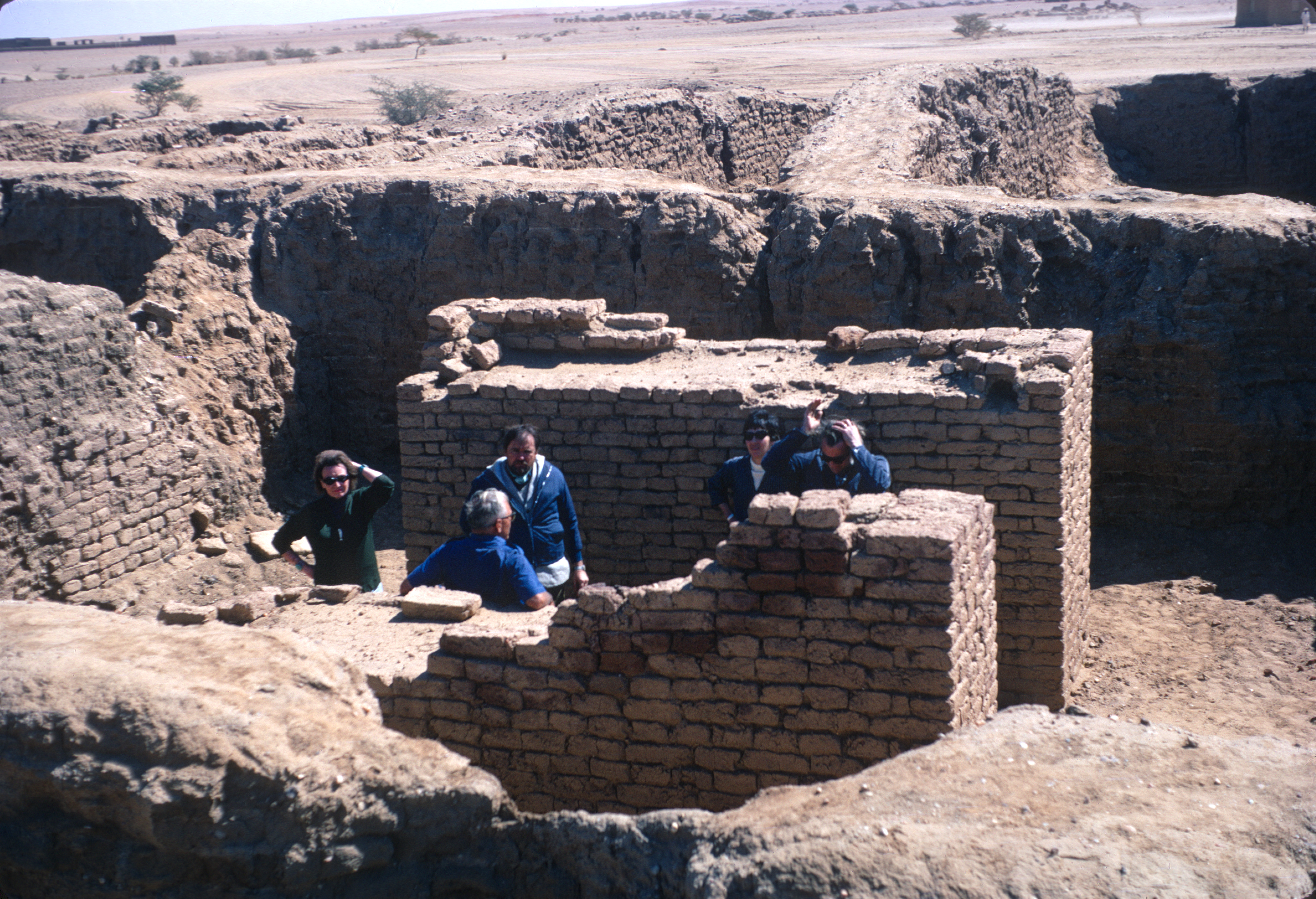
The temple at Naqa, with Margaret Shinnie, her husband, Mr and Mrs Basil Davidson, George Scanlon and on excavation. SARS Bonner Archive BON-S007.18
Like her counterparts among other archaeological couples, Margaret Shinnie’s contributions are hard to untangle from her husband’s, and often have to be sought out in the footnotes and acknowledgements of books published by others. The account of her life in the SAR Newsletter emphasized her “work [on] domestic arrangements in a large camp” and “editing and proof reading” (Alexander 1995), omitting the books that she authored (M. Shinnie 1954, 1965), co-authored (1978), and translated (1966), her direction of fieldwork in Sudan during the first season at Ghazali (and co-direction at Amara West, Soba, Tanqasi, Debeira West, and Meroë), her illustrations and maps, articles, chapters, and book reviews. At Soba, the medieval capital of the Christian kingdom of Alwa in Sudan, the soil was compact and strata could be distinguished by wetting the earth with a spray bottle. Margaret produced the first published stratigraphic section from the Nile valley in Excavations at Soba (P.L. Shinnie 1955).
“The draughtsman has even greater difficulties than the writer, sweat pours on to the paper, the paper itself becomes brittle in the dryness and breaks; if tracing linen is used instead, cockroaches eat the size. Indian ink dries on the pen between the bottle and the drawing board. If advantage is taken of the cooler evenings, swarms of nimitti, a small fly, clog the ink and settle on the pen nib. In spite of these difficulties, the work has been done and I owe thanks to my wife for her valiant attempt to defy nature and produce the drawings” (P. Shinnie, 1955, p.7).
Margaret studied Modern Languages (French and German) at St Hugh’s College, Oxford. She had a talent for languages and later took up Arabic to direct archaeological fieldwork in Sudan. She entered the Civil Service with the Board of Trade during the Second World War and, then, the Sudan Political Service in the Department of Economies and Trade. However, the roles played by female colonial administrators in imperial rule and colonial frameworks of archaeology are often overlooked, partly because the administration of the British Empire is so often typified by the District Commissioner, “the man on the spot” who embodied the colonial government (Kirk-Greene, 2000, p.186).
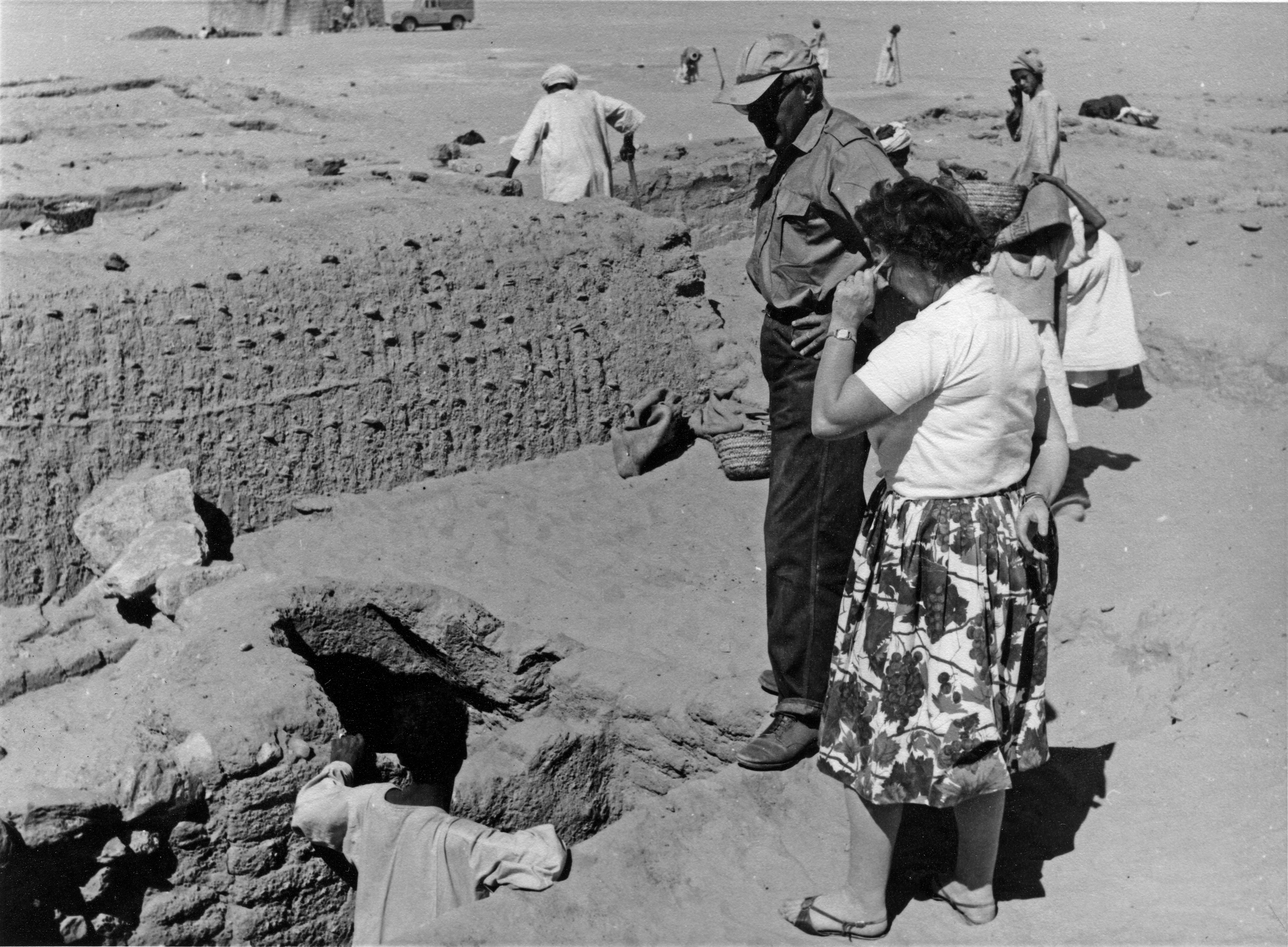
Peter and Margaret Shinnie excavating at Debeira West. SARS Bonner Archive P009-01.
Margaret first went to Khartoum in 1946, with her husband, Peter, who replaced A.J. Arkell as the Commissioner for Archaeology there in 1948. During this time the Antiquities Service was expanded and the material that had been somewhat haphazardly displayed in two dozen cases in Gordon Memorial College (later, the University of Khartoum) were taken to a nearby house on the Nile esplanade, which had been converted into an archaeological museum for this purpose. They left Sudan, in June 1955, when Peter was replaced by the French archaeologist Jean Vercoutter as part of the Sudanization of government posts (on the theory that a French archaeologist was preferable to a British one; Thâbit Hassan Thâbit replaced Vercoutter as the Commissioner for Archaeology in later round of Sudanization.) Seven years later, the Shinnies returned in 1966-1969 to excavate Debeira West as part of UNESCO’s International Campaign to save the Antiquities of Nubia in advance of the rise of Lake Nasser behind the Aswan High Dam. In the interval, they went to Uganda and then Ghana, where they excavated at Yendi Dabari, a former capital of the Kingdom of Dagbon (see P.L. Shinnie, 1990, p. 232 fig 13.3).
Throughout her career, Margaret Shinnie worked to make archaeology accessible to “the general reader.” Her A Short History of the Sudan (Up to A.D. 1500) (1954) was the first volume of the Museum Pamphlet series published by the Sudan Antiquities Department for visitors to the Museum of Antiquities in Khartoum. Later she was prompted to begin work on one of the first syntheses of pre-colonial African cities and states by “a young African archaeologist,” who told her about how while studying geography in an African university he had been asked to “show how to reach the suburb of Hampstead from Blackfriars Bridge by underground train” (M. Shinnie, 1965, p.9). The result, Ancient African Kingdoms (1965), proved so popular that thirty-four editions in three languages were published between 1965 and 1982.
Ancient African Kingdoms was a part of a pivotal period as newly independent states created nationalist and anti-colonial narratives and scholarly interest shifted from the study of colonial states to the study of indigenous kingdoms and societies. Its Anglo-centrism is very much a product of its author’s time and place. (She mostly ignored the work of African, French, and American scholars.) Apart from this, it is a not a particularly self-revelatory book; the chapters that describe sites in Sudan, Uganda, and Ghana give no indication she had excavated there or visited these sites. She wrote it to help her readers to think about the achievement of independence, holding out thousands of years of African civilization as an argument for a promising future of self-rule. She meant the book to provide an introductory text for students at African Universities who had not yet chosen a career, she said, “in the hope that some of them may be sufficiently interested … to pursue the exploration of ancient Africa further” (M. Shinnie, 1966, p.7).

Maragaret Shinnie at the site of the temple at Basa. SARS Bonner Archive S008.06.
Margaret Shinnie left Sudan in 1969 and returned to England. She served on the Council of the British Institute in Eastern Africa (BIEA) and as assistant editor of the Geographical Journal of the Royal Geographical Society until her retirement in 1985. She was a frequent reviewer for the Journal, and preferring accounts of travel and exploration, she introduced readers to Father Jeronimo Lobo’s travels to India and the East African Coast in the early 1600s, the caravans of Central Asia and the Sahara, and Robin Fedden’s travels in Egypt. In the early 1980s, she returned to Soba East in Sudan, where she had excavated for two seasons in 1950-1952. She used her good Arabic and connections in the Sudan Antiquities Service to help set up the BIEA’s renewed excavations at Soba and took part in two seasons there in 1981-82 and 1982-83. Though mostly remembered in dozens of acknowledgements for the help she gave to others—she proofread the final report of the BIEA’s project at Soba East—her contributions to field methods and to bringing archaeology to a wider public merit her place among Trowelblazers.
Guest Post by Brendan Tuttle
Edited by Brenna
Images Courtesy Sudan Archaeological Research Society Bonner Archive and reproduced with permission.
Website: www.sudarchrs.org.uk
Wikipedia: https://en.
Follow us on Twitter: @Sudan_Nubia
Join our Facebook group: Sudan and Nubia (SARS) unofficial
YouTube channel: www.youtube.com/use/sudarchrs
References
Alexander, John Amyas
1995 Margaret Shinnie (obituary). Newsletter of the Sudan Archaeological Research Society, 8, June, pp. 47.
Kirk-Greene, Anthony
2000 Britain’s Imperial Administrators, 1858–1966. London: MacMillan.
[But see Janice Boddy’s (2007) Civilizing Women: British Crusades in Colonial Sudan (2007, Princeton University Press) and Nupur Chaudhuri & Margaret Strobel’s (eds.) Western Women and Imperialism: Complicity and Resistance (1992, Indiana University Press).]
Shinnie, Margaret Blanche Elizabeth
1971a Civilizations of the Nile. In The Horizon History of Africa. Alvin M. Josephy, Jr., ed. New York: McGraw-Hill.
-1971b The People of Meroë. In Africa: Tradition and Change. Evelyn Jones Rich and Immanuel Maurice Wallerstein, eds., pp. 105-107. Random House School Division.
-1954 A Short History of the Sudan (Up to A.D. 1500). Khartoum: Sudan Antiquities Department.
-1958 Linant de Bellefonds, journal d’un voyage à Méroé dans les années 1821 et -1822. M. Shinnie, trans. Khartoum: Sudan Antiquities Service.
-1966 Ancient African Kingdoms. New York: St. Martin’s Press.
-1978 (with P. Shinnie) Debeira West: A Mediaeval Nubian Town, University of Ghana Expedition to Nubia. Oxford: Aris & Phillips.
Shinnie, Peter Lewis
[They met at Oxford and married in 1940, when Peter was serving as a reserve officer in the Royal Air Force and trying not to bomb ancient sites in Italy. They later divorced.]
-1955 Excavations at Soba, with a Section on the Glass by Donald Benjamin Harden. Khartoum: Sudan Antiquities Service.
-1990 A Personal Memoir. In A History of African Archaeology. Peter Robertshaw, ed., pp. 221-270. Oxford: James Currey.
-1995 Margaret Shinnie: an additional note. Newsletter of the Sudan Archaeological Research Society, 9, November, pp. 24-25.





Fascinating to read all this about Margaret Shinnie. I knew her as the mother of my dear friend Caroline as a child in Sudan in the fifties. I knew Peter was an archaeologist but had no idea Margaret was too. I came across this while searching to see if I could track down Caroline. If any one can put me in touch I’d be grateful.
I hope someone reading this comment might be able to find out; apologies but I don’t have any contact information for the family! Best of luck though!