
Egyptology can be depicted as a very male-dominated field – think of Howard Carter, Flinders Petrie, the list goes on. However, this undermines the integral role women have played in the discipline from the very start, both in more domestic roles and in actual excavations. Most notably, records typically omit or quietly reference the ‘Mrs’, who would sort pottery, or record paintings and inscriptions whilst her husband oversaw digging elsewhere.
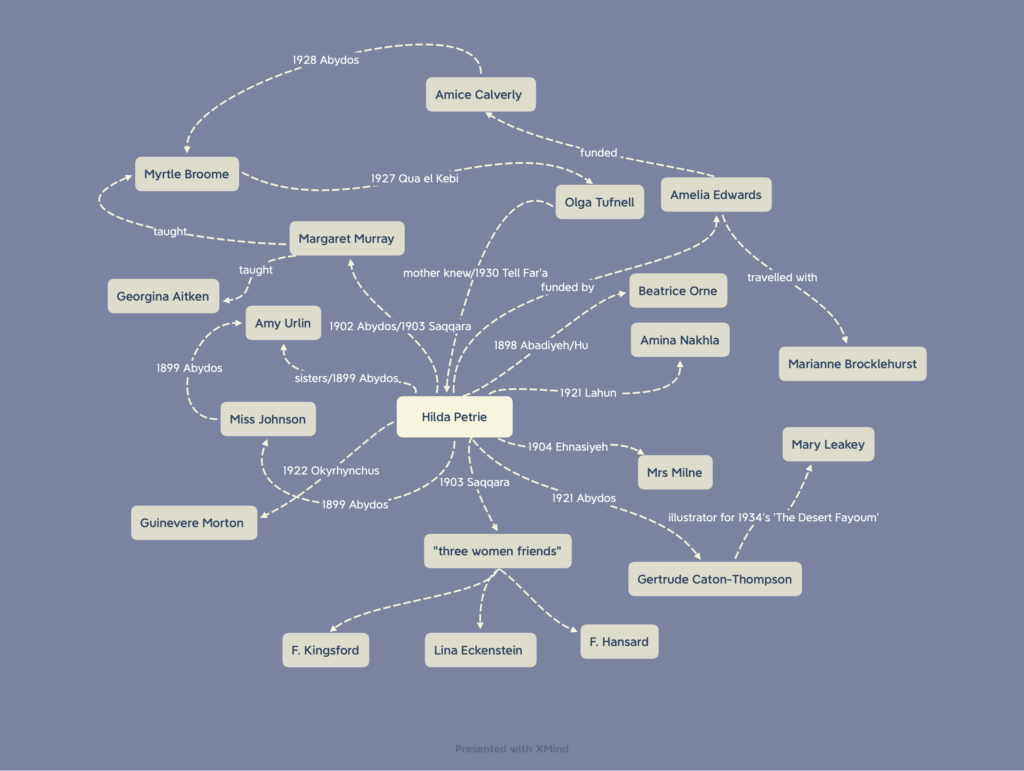
In this map, I have attempted to make very general connections between women in early 20th century Egyptology. Some of these women have biographies on this website already – see Hilda Petrie, Amelia Edwards or Margaret Murray. However, many seem to have practically disappeared from the records all together – Guinevere Morton, for instance, whose name is also spelt as Norton in Hilda Petrie’s letters. Further research is much needed.
Most of these connections are excavations both of them worked on, for instance Olga Tufnell and Myrtle Broome being connected by the 1927 dig at Qua el Kebi. Some of these connections, meanwhile, are familial – Amy Urlin, who worked on the 1899 Abydos excavation, was the sister of Hilda Petrie. Some of them were academic – Margaret Murray, a lecturer in Egyptology at the Institute of Archaeology (and indeed the first female archaeology lecturer herself), taught several female Egyptologists, including Georgina Aitken and Myrtle Broome. One link I found particularly fascinating was that between Gertrude Caton-Thompson and Mary Leakey – Caton-Thompson employed a young Leakey to illustrate her 1934 book ‘The Desert Fayoum’.
I decided to focus my research around Hilda Petrie, as she potentially had the widest network from her many field seasons and academic connections, and also an existing collection of letters! However, this means the map sorely lacks any non-British, and certainly non-white, archaeologists. I realised a complete overview would be beyond the scope of the project, so decided to focus on a very small circle of British female Egyptologists in the early twentieth century. Although perhaps obvious, it must be stated that this misrepresents the true composition of Egyptology at the time.
Full resolution figure permalink: https://figshare.com/articles/figure/Women_in_20th_Century_Egyptology_pdf/20438721
Posted by Esme Goodwin as part of the 2022 TrowelBlazers Digital Fieldwork Project.
Further Reading & References:
- Caton-Thompson, G. 1934. The Desert Fayoum. The Royal Anthropological Institute of Great Britain and Ireland: London.
- Drower, M. S. 2004. Letters From The Dead: The Correspondence of Flinders and Hilda Petrie. Aris & Philips Ltd: Oxford.
-
Goodwin, E. 2022. Network Diagram of Women in 20th Century Egyptology. figshare. Figure. https://doi.org/10.6084/m9.figshare.20438721.v3
- Murray, M. and Petrie, H. 1952. Seven Memphite Tomb Chapels. British School of Archaeology in Egypt: London.
- Petrie, H. 1927. Egyptian Hieroglyphics of the First and Second Dynasty. Quaritch: London.


My introduction to women in the field was through the work The Road to El-Aguzein by Marjory Veronica Seton-Williams.