Dr. Frances Wagner was a pioneer in the study of micropalaeontology. She was also part of the first generation of Canadian geologists with the privilege of being mentored by other women scientists, which directly contributed to her success in the field and the lab.
Wagner was born in 1927 in Hamilton, Ontario. Her childhood was spent outdoors- canoeing, hiking, and reportedly identifying lichens with her younger brother near the family cottage. Wagner began her career at the Geological Survey of Canada as a full-time student in 1949 cataloguing fossils, and embarked on her first field excursion in 1950 immediately after completing her M.A. at the University of Toronto. This was the same summer that Dr. Helen Belyea became the first Canadian woman to conduct extensive geological field work alongside a male colleague.

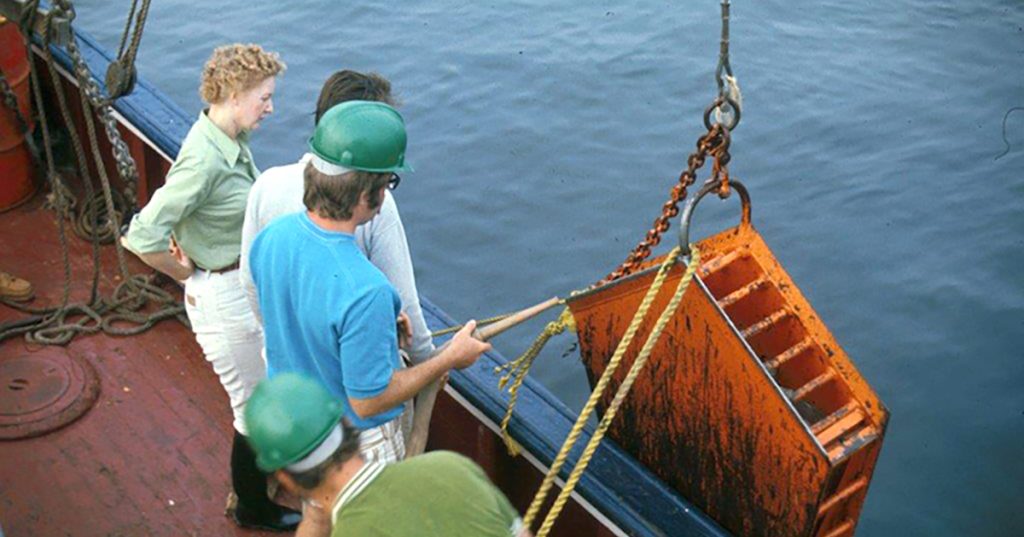
Wagner aboard a vessel bringing up a device used to drag the sea floor for sediments containing microscopic fossils. Image courtesy science.ca and used with permission.
In 1952 Wagner completed her M.Sc. in geology under the field supervision of Dr. Alice Wilson, who single-handedly set up the groundwork for other Canadian women geologists like Wagner and Belyea to conduct field work. Wagner’s Ph.D. was supervised by yet another female geologist: Dr. Myra Keen of Stanford University. Each of these geologists was known to take female students in the lab and in the field, effectively building a legacy of women in science.
Wagner became an expert in the micropalaeontology of ancient seas in Canada, and an expert in the microbiota of the Arctic and Atlantic continental shelves. She collected sea floor sample cores on countless marine expeditions. She also conducted core analysis work in the Caribbean and the Canadian Maritimes, eventually moving to Nova Scotia in 1967 to work at the Bedford Institute Laboratory. Wagner went on to serve on the first purpose-built Canadian research vessel, the Hudson, along the Northwest Passage from November 1969 to October 1970. All of this was accomplished through an insatiable passion and dedication to the study of microorganisms.
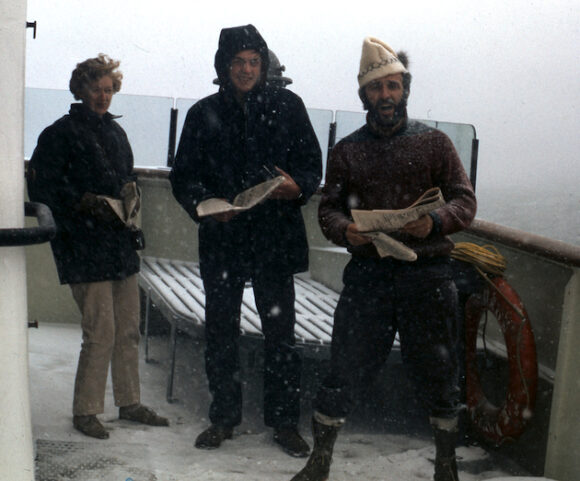
Frances Wagner with scientific staff aboard CSS Hudson in 1970 in the Northwest Passage. Image courtesy science.ca and used with permission.
Wagner never married, stating “no, I was a career girl,” when asked if she’d had any children. Until 1955 there was legislation in place in Canada allowing employers to terminate female employees if they married, and the stigma against working mothers persisted long after it was repealed. After retirement in 1984, Wagner picked up her childhood hobby of horseback riding, as well as dog breeding. Wagner passed away in 2016, leaving behind a legacy of adventure and scientific dedication.
Post by Brigid Christison
Brigid is the founder of PalaeoPoems.com (@PalaeoPoems on twitter), an anthology of palaeo-themed poetry through history.
Edited by Brenna
Images courtesy of science.ca (http://www.science.ca/scientists/scientistprofile.php?pID=471) and used with permission.