

Zonia Baber
Mary Arizona ‘Zonia’ Baber (1862-1955) is recognized as a pioneer in geography education, and an important figure in promoting equal rights for women and minorities. She emphasized the importance of practical fieldwork and laboratory work in geography teaching, and the importance of applying geographic concepts rather than just memorizing names and places, pedagogic approaches that are still praised and encouraged today.
She earned her teaching credential in 1885 from Cook County Normal School (which later became Chicago State University. ‘Normal schools prepared school teachers and later became known as state teacher’s colleges). In 1887 she was recruited as a staff member at Cook County Normal and became their Head of Geography from 1889 – 1901. Following this, she held a position as an Associate Professor in the Department of Education at the University of Chicago (Teacher of Geology and Geography, 1901-1921). While teaching, she also began taking classes, including the first geology class that allowed women and earned her Bachelor of Science degree in 1904. Multi-tasking Trowelblazer extraordinaire, she also co-founded the Geographic Society of Chicago in 1898, at the same time as teaching, running a department, and earning her degree. She remained involved with Society throughout her life, serving as its president from 1900-1904. In 1948 she received the society’s Gold Medal lifetime achievement award. Like Florence Bascom, she was listed as one of the few women in the American Men of Science.

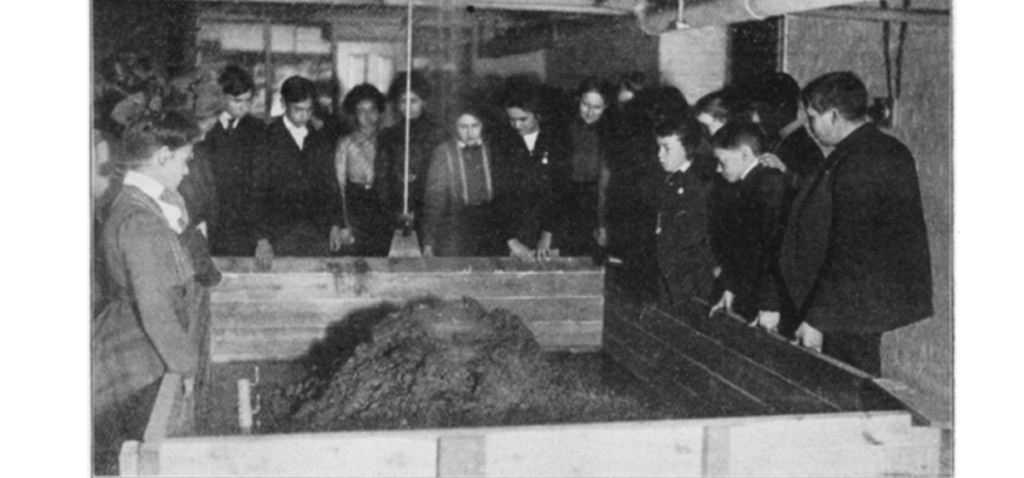
Reproduced from open access article : Geography by
Zonia Baber, published in ‘The Course of Study’ Vol. 1, No. 8 (Apr., 1901), pp. 704-706
Her efforts to promote women in geography are lessons that we can learn from today and mirror the efforts of the Trowelblazers website to highlight their important contributions. She recognized that women were often excluded as speakers at events due to both prejudice and lack of knowledge of their existence, and deliberately sought recommendations for female speakers for the Chicago Geographical Society from fellow Trowelblazer Harriet Chalmers Adams (first president for the Society of Women Geographers). In 1927 Baber herself became president of the SWG.
Outside of geography she was also actively involved in suffrage and promoting women’s rights. Baber traveled extensively around the world from Europe to the Middle East, East Asia to the Pacific Islands and the Caribbean, both professionally attending conferences, and also related to her political work. She worked to address racism and the threat of imperialism as well as women’s issues, arguing for racial integration as a priority within the Women’s International League for Peace and Freedom. She was a tireless advocate for women’s suffrage, and in addition to serving on the Race Relations Committee of the Chicago Women’s Club and the Executive Committee of the Chicago Branch of the National Association for the Advancement of Colored People, she also served on the Board of Managers of the Women’s International League for Peace and Freedom, and as representative for Puerto Rico for the National Women’s Party, the Asociación Puertoriqueña de Mujeres Sufragistas, and the Liga Social Sufragistas.
Post submitted by Lisa-Marie Shillito
Edited by Brenna
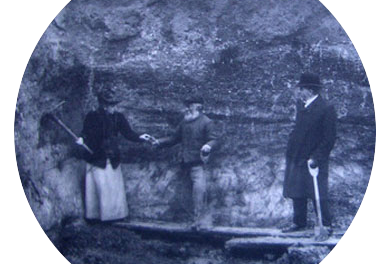
Main Image: Zonia Baber gathering fossils at Mazon Creek, Illinois, 1895. The summer class in Geology, taught by Thomas C. Chamberlin, was the first field class at the University of Chicago to which women were admitted. Image courtesy University of Chicago Photographic Archive, [apf1-00303], Special Collections Research Center, University of Chicago Library
Landscape Image: Reproduced from open access article: Geography by Zonia Baber, published in ‘The Course of Study’ Vol. 1, No. 8 (Apr. 1901), pp. 704-706. The University of Chicago Press http://www.jstor.org/stable/992015



I’ve recently learned that she also patented a desk designed to hold all of the materials a student would need to “create” a landscape! https://www.smithsonianmag.com/science/woman-who-transformed-how-we-teach-geography-180967859/
Thank you so much for this article. I am looking for any and all information I can find on “Aunt Zonia”. She was my grandfather’s great-aunt. My family has letters and a pucblication of her book Peace Works that we found while going through my grandparents estate. When my mother was a very young child, she met her shortly before her death in 1956.
Emily, I am looking for Zonia Baber. I am geologist too.
Are you going to publish the information you have collected?
I think your aunt was an exceptional woman and should not be missed
Thank you for saving her items
Best regards
Anabel