
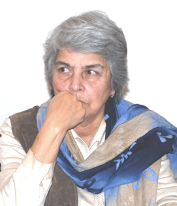
Solmaz Kashkay (1936-2011) was the first woman cuneiform reader in Azerbaijan. She made an enormous contribution to the study of Azerbaijan’s history and culture of the Late Bronze Age and the Iron Age. She obtained a degree in history from Baku State University in 1960. Shortly afterwards, through the combination of prodigious hard work, she spent several years in St. Petersburg to learn the Urartian and Akkadian languages from the renowned scholars Lipin and Diakonoff; the study of these languages would later become the hallmark of her career. She had an immense knowledge of the major languages of the ancient Near East, including Sumerian, Akkadian, Assyrian and Urartian. Her publications, “The History of Mannea State” (1977) in Russian and “The State of Mannea” (1993) in Azerbaijani, found success among critics and the general public. She contributed to the broader understanding of Azerbaijani history, its borders and frontiers, and migration processes, through the study of ancient languages.

Solmaz Kashkay (fifth from the left). Khazar University, ‘Knowledge and artistry’ gathering 2009, Image courtesy B. Ibrahimli
In the 1980s, Kashkay co-directed large-scale archaeological investigations in Nakhchivan. Throughout her excavations she tried to understand the relations between Nakhchivan and its neighbouring regions, such as Urmia Lake Basin in Iran during the Late Bronze Age and Iron Age. Furthermore, Kashkay’s importance in promoting and developing the study of migration processes cannot be overstated. She had several papers dedicated to the Scythians in Azerbaijan during the second and first millennia BC.

Solmaz Kashkay (first from the left). Alikomaktepe excavation 1976, Image courtesy B. Ibrahimli.
Beyond her academic contributions, Kashkay had firmly established herself as someone who has gained the respect and fondness of colleagues the world over. She worked in collaborative projects with archaeologists from Moscow and St. Petersburg. She worked on Urartian sources alongside the distinguished scholar Diakonoff who dedicated his life to the study of the Ancient Near East and its languages for many years. As a result of this successful collaboration the paper ‘Geographic Names according to Urartian texts’ was published in 1981 in Wiesbaden, Germany.
Possibly one of Solmaz Kashkay’s most important contributions to history and archaeology was through her teaching. She was a constructive and supportive supervisor, full of wisdom and good advice. Students were, without question, her first priority. She taught history at several different universities, including Baku State University and Khazar University, which attests to the fact that many doctoral and research students benefited immeasurably from her guidance and wealth of knowledge during her career.

Solmaz Kashkay (second row, first from the left), Karvansara excavation 1984, Image courtesy B. Ibrahimli.
She had a remarkable personal generosity with her many unsolicited acts of kindness. This was clearly manifest in her warm attitude towards local people living near excavated fields in different regions. Memories dedicated to her life reveal that she was even invited to the weddings of local people after they had worked with her in excavations. She always believed in public archaeology so that the general public could learn from the discoveries of the discipline, and tried to raise awareness among local people about the archaeology and history of their land. This inspired many young women, which led them to volunteer under her supervision in different excavations.
Post by Narmin Ismayilova
Images of Solmaz Kashkay courtesy B. Ibrahimli and used with permission.




We worked with Solmaz Kashkay for 12 years in the Kharaba Gilan archaeological expedition, which conducted excavations in the Gilanchai river valley. S. Kashkay was a talented scientist, and I would say, she was more of an archaeologist than a historian. Thank you, Nermin khanym, for a brief but clear assessment.
Tesekkur edirem Behlul Muellim !
Well done! Informative, well written article.
Thank you very much for reading. I am glad you enjoyed it.