

This article covers the history of feminist archaeology in North America and parts of Europe, where there was a distinct label was given to this new approach to archaeological thinking. Elsewhere in the world, women’s access to, and role within, the discipline evolved without being labelled as a movement in the same way.
In order to discuss meaningfully the aims, history and relevance today of feminist archaeology, the development of archaeological theory must first be explained. Prior to the 1980s, archaeologies focused on examining reasons for cultural change that were scientifically/factually grounded, allowing generalised models for change to be constructed. This approach was labelled “processualism”. However, this received criticism for being overly mechanistic and unable to adapt to complex variables in different contexts or account for human action in society. As a result, “post-processualism” emerged; this emphasised the role of individuals and ideological or symbolic aspects of society in change. Within this school of thought, the objectivity of archaeology was also called into question, with people arguing that interpretations of the past can never claim to be purely scientific and unbiased.
Feminist archaeology developed as part of post-processualism in the UK and North America, but also as a response to second-wave feminism. Initially feminist archaeology was concerned with the invisibility of women in our reconstructions of the past. However, the methods of archaeological knowledge production were soon also criticised as it was felt gender bias was influencing our interpretations of the past. Therefore, feminist archaeology is simultaneously an attempt to transform knowledge about past societies and reshape our approach to the discipline.
It is also worth noting that gender archaeology developed contemporaneously with feminist archaeology, and the two are intricately linked. Gender archaeology originally grew from the social sciences reframing of ‘gender’ as a social or cultural construction, whilst biology (male or female) defined ‘sex’. This allowed for a more nuanced reading of social roles, identity, and ideology and how these are influenced by changing cultural notions of gender. Feminist archaeology used these ideas of gender, but gender archaeology is a sub-discipline in its own right.
Influential Works:
Norway was amongst the earliest places to develop a feminist archaeology. In 1979 there was a Norwegian conference organised by teachers and museum creators titled “Var de alle menn?” (“Were they all men?”). Later, in 1985, Norwegian feminist archaeologists launched the journal K.A.N: Kvinner i arkeologi i Norge (Women in Archaeology in Norway).
Margaret Conkey and Janet Spector’s Archaeology and the Study of Gender (1984) was the pioneering explicitly feminist paper in North America. They argued that archaeology, when viewed through the feminist critique, is “neither objective nor inclusive on the subject of gender” and presented a practical feminist approach. It is also in this paper that ideas of gender as “a system of social rather than biological classification that varies cross-culturally and changes over time” were presented.
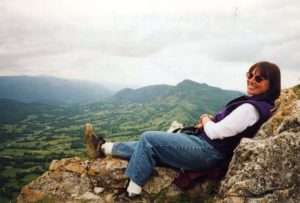
Meg Conkey pondering landscape in the Pyrenees. Image source: Meg Conkey, with her permission. All rights reserved.
In Britain an entire issue of the Archaeological Review from Cambridge (Arnold et al. 1988) titled “Women and Archaeology” was dedicated to gender and feminist issues. The conditions in which women work in archaeology were discussed as was the portrayal of women in interpretations of the past.
In 1991 the seminal volume Engendering Archaeology by Joan Gero and Margaret Conkey was released off the back of the 1988 conference “Women and Production in Prehistory”. This series of papers challenged previous assumptions about men’s societal contributions and sought to legitimise gender as an issue for discussion.
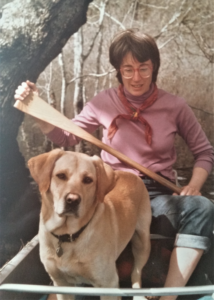
Joan Gero and dog Carino in the Sparkleberry Swamp, University of South Carolina (about 1985). Image provided by Stephen Loring.
Alison Wylie was also hugely influential in the early formulation of feminist archaeology and published in both North America in American Antiquity (1992a) and in Norway in the Norwegian Archaeological Review (1992b). She argued that the feminist perspective “may well enhance the conceptual integrity and empirical adequacy of archaeological knowledge claims” (1992a: 15).
Janet Spector’s book What This Awl Means: Feminist Archaeology at a Wahpeton Dakota Village (1993) marked the point at which feminist concerns began to parallel those of class and race. It was also the first feminist archaeology book to be published in a narrative voice, prompting a movement away from technical archaeological reports to more engaging work.
Other key contributors to the discussion have been Judith Butler, Rosemary Joyce, Ruth Trigham, Silvia Tomášková, and Ruth Whitehouse.

Ruth Whitehouse at Cambridge in 2015. Image courtesy of Ruth Whitehouse
Since the 1990s, feminist archaeology broadened its concerns to examine other problematic depictions of social categories in the past — such as race, sexuality, age and class. Meanwhile, gender archaeology has developed into discussions of sexuality and “embodiment” — a concept exploring non-binary identity.
Thus despite originally focusing on unearthing the lives of women in the past, the discipline has gone on to explore the ways in which the past and present relate to one another, how modern biases inform interpretation, and to challenge traditional androcentrism. But nowadays feminist discussions are rarely solely concerned with just women, and the self-reflective approach offers a theoretical framework that can be used to uncover the stories and contributions of other marginalised groups and individuals throughout history.
Post by Alice Locke as part of the 2022 TrowelBlazers Digital Fieldwork Project.
Further Reading:
Alberti, B. and Danielsson, IM.B. (2014). Gender, Feminist, and Queer Archaeologies: USA Perspective. In: C. Smith, ed. Encyclopedia of Global Archaeology. New York: Springer. Available at: https://doi.org/10.1007/978-1-4419-0465-2_1024
Dommasnes, L.H. (2014). Gender, Feminist, and Queer Archaeologies: European Perspective.. In: C. Smith, ed. Encyclopedia of Global Archaeology. New York: Springer. Available at: https://doi.org/10.1007/978-1-4419-0465-2_1025
There are also entries in the Encyclopaedia of Global Archaeology on processualism, post-processualism, and Australian and Spanish perspectives on feminist archaeology.
Tomášková, S. (2012). Feminist Archaeology. In The Oxford Companion To Archaeology. Oxford: Oxford University Press. Available at: https://www.oxfordreference.com/view/10.1093/acref/9780199735785.001.0001/acref-9780199735785-e-0151
Mentioned Works:
Arnold, K., Gilchrist, R., Graves, P. and Taylor, S. (1988). Women in Archaeology. Archaeological Review From Cambridge, 7(1), pp.2-8.
Conkey, M. and Spector, J. (1984). Archaeology and the Study of Gender. In: Advances in Archaeological Method and Theory, pp. 1-38. Academic Press.
Gero, J. and Conkey, M. (1991). Engendering Archaeology: Women and Prehistory. Wiley-Blackwell.
Spector, J. (1993). What This Awl Means: Feminist Archaeology at a Wahpeton Dakota Village. Minnesota Historical Society Press.
Wylie, A. (1992a). The interplay of evidential constraints and political interests: recent archaeological research on gender. American antiquity, 57(1), pp.15-35.
Wylie, A. (1992b). Feminist Theories of Social Power: Some implications for a processual archaeology. Norwegian archaeological review, 25(1), pp.51-68.



hello,
i’m surprised thqt feminist archaeologists discount or erase the work of Marina Gimbutas, who posthumously received a UNEsO award — could she please be re-incorporated into this narrative that leaves her out? Thank you so much, a fellow researcher..
hello,
i’m surprised that feminist archaeologists discount or erase the work of Marija Gimbutas, who posthumously received a UNEsO award — could she please be re-incorporated into this narrative that leaves her out? Thank you so much, a fellow researcher..