Born in Scotland to pioneer anthropologist Ursula Graham Bower, and ornithologist Frederick Nicholson Betts, Dr. Alison Betts (Alison) is a leading archaeologist on prehistory in the Near and Far East. She completed her thesis on ‘The Prehistory of the basalt desert, Transjordan: an analysis’ (1986), and completed her education at the University of Edinburgh, Queen’s University Belfast, the University of Sydney, and the University of London. She currently works as a professor of Silk Road Studies at the University of Sydney and has many collaborative projects.
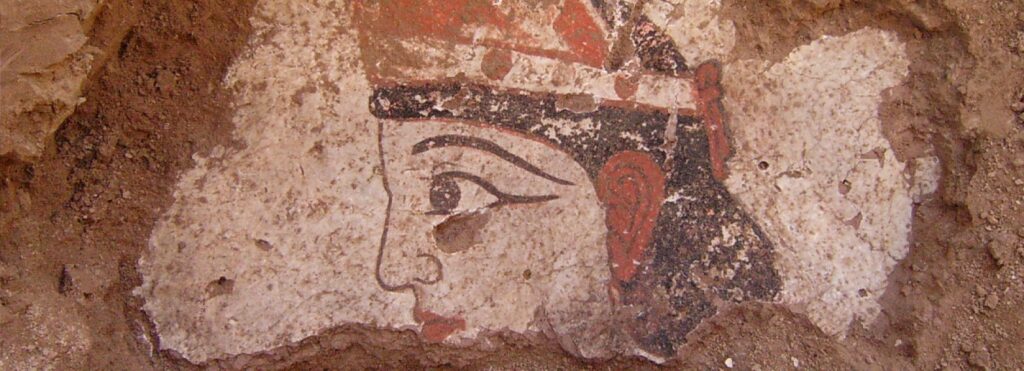
Alison was first exposed to the Middle East in 1973 when she was offered the opportunity to participate in the Abu Hureyra project in Syria. She quickly became captivated by the Middle East and its prehistory and remained working primarily in Jordan until 1991. She was then invited to collaborate on the Karakalpak-Australian Expedition in exploring the archaeology of the ancient royal city of Akshakhan-kala in the delta of the Amu-Darya. This site has become famous for its magnificent wall paintings and ceremonial buildings associated with a cult of fire.

Frescoe from Kazakly-Yatkan (Akcha-Khan Kala)
Throughout this period, Alison was inspired to learn more about Central Asia, and in particular, the Eastern part of China, Xinjiang, leading to her new work centering around early crop dispersals along the Southern Himalayan rim.
When asked about her experiences as a woman within the field of archaeology, Alison responded:
“Interestingly enough, I do not think that I have faced much difficulty as a woman in archaeology. In some cases it has been an advantage, I suspect. There is sometimes a cultural tension where archaeologists come into low income communities. Foreigners may be resented. But where men might face some antagonism, this is less so for women who are normally treated only with politeness. In certain communities where women are not usually in positions of influence and where meetings may be for men only, I have simply been regarded as an honorary man. There is a bit of a delicate dance sometimes between both worlds and it is necessary always to be aware of how to best behave appropriately.”
Alison’s work has not only greatly contributed to our knowledge of the lands along the Silk Roads, but has also given us insights as to what it is like to be a modern-day female archaeologist. More information about her work can be found in the links below
https://www.researchgate.net/profile/Alison-Betts
https://www.abc.net.au/news/alison-betts/33566
https://youtu.be/3N-hQxJR6qQ?list=PLXSDVg9HvDBgWqaCy2ir2enKV45bj_MrQ
References:
https://www.sydney.edu.au/arts/about/our-people/academic-staff/alison-betts.html
https://en.wikipedia.org/wiki/Alison_Betts
https://au.linkedin.com/in/alison-betts-53bb7018
Guest Post by Genevieve Cheung as part of the 2021 UCL TrowelBlazers Digital Fieldwork Project.