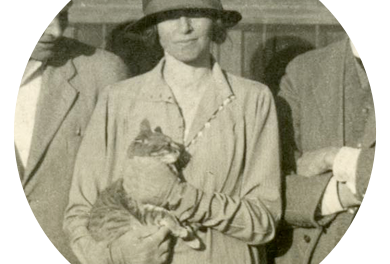
Annie Ure was among the first female British archaeologists to lead an excavation in Greece. Being an expert in Boeotian Archaeology, she went on to co-found a museum with her husband and curate their museum for 54 years until her death in 1976.
Annie was born Annie Dunman Hunt, in 1893 in Worcester, the youngest of seven children. Annie attended Stoneycroft, a small boarding school for girls in Southport, where she met Nora Kershaw (later Chadwick) who became a noted Anglo-Saxon and Celtic historian. Annie went on to study Classics at the University College, Reading. She took external exams at the University of London and received an upper second-class degree in 1914.

Annie Ure as a young student. Image courtesy of the Ure Family Archives, with thanks to Bonnie Ure
After earning her degree, she taught for a short while at Stoneycroft before being charmed back to Reading’s Classics Department by her professor, Percy Ure, to complete a post-graduate degree. Soon Annie was required to assist Professor Ure with lectures after the other male staff was conscripted into the army for the war effort. After working with him for a little under a year, Annie married Percy Ure in 1918.
In 1921 they traveled to Greece together to conduct an excavation at Rhitsona, in Boeotia, a site that Percy had previously worked on with archaeologist Ronald Burrows in 1908. They excavated the necropolis of what was thought to be the ancient Boeotian town of Mykalessos. During these excavations Annie kept meticulous diaries of their trips and recounted the richness of the graves, sometimes including up to 400 artifacts.

Annie (center, back row) with the excavation team at Rhitsona, Greece. Image courtesy Ure Museum of Greek Archaeology at the University of Reading.
Returning to the University College, Reading, the Ures collated their findings from Rhitsona with those of Burrows. Their book Sixth and Fifth-Century Pottery from Rhitsona is generally considered to be one of the most extensive records of Boeotian pottery. Alongside their publication, the Ures established a museum at the University College, which held several small collections and donations of Greek and Egyptian antiquities. Annie became its first curator and served the museum for 54 years until her death.
Together with her successful academic career, Annie had a highly fulfilling family life, having borne two children, Jean in 1924, and Bill in 1926. Despite her growing family, Annie never lost her passion for Boeotian and related archaeology or stopped working. In the early years of her children’s lives, Annie traveled extensively around Europe and the Mediterranean, visiting many museums in which she acquired knowledge and contacts.
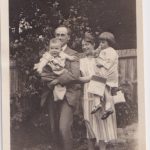
Percy and Annie Ure with their children, Bill and Jean. Image courtesy of the Ure Family Archives, with thanks to Bonnie Ure.
She began teaching at the local ‘Abbey School’ in Reading to fund her trips across Europe; her income significantly decreased after her husband’s death. In 1963 she retired from the Abbey School to teach at the University of Reading and continue to curate the museum. In 1976, 10 days before her death, the University bestowed on her an honorary doctorate for her contributions, which spanned over 65 years. The museum, which was renamed the ‘Ure Museum of Greek Archaeology’ to honor Annie and her husband, is still open today at the University of Reading.

Guest post by Ruth Lloyd
Ruth’s poster on Annie is part of a special event at the Parliament of the United Kingdom, celebrating undergraduate research. Congratulations Ruth on your TrowelBlazing achievements!!!
edited by Brenna