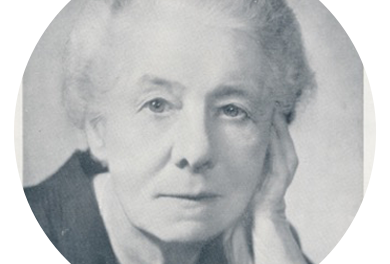
Anna Apostolaki was the first at many things: the first woman to work professionally in the field of archaeology in Greece; the first woman to be admitted membership to the Archaeological Society of Athens (1906 with life membership in 1925); one of the first 10 female graduates of University of Athens and the first from Crete in 1909. She is perhaps best known for her roles as curator and later director of the National Museum of Decorative Art at Athens (formerly the Museum of Greek Handicrafts, now the Museum of Greek Folk Art), and her work with ancient Greek textiles to both validate women’s work, and Greek nationalism in the interwar period.

Tzistarakis Mosque in Monastiraki Square, the original building the Museum of Greek Handicrafts was founded in
Source: Wikimedia Commons
Anna Apostolaki’s life was remarkable from the start. Born in 1881 in Margarites near Rethymnon, her family fled to Piraeus then Athens in the 19th century following Cretan revolutions against Ottoman rule. She enrolled in the School of the Society for the Promotion of Education and Learning (Αρσάκειο), graduating as a teacher in 1899 – one of only occupations available to women at the time. However, by 1903 she enrolled in the Philosophical School of the University of Athens while also working as Ioannis Svoronos’ assistant at the Numismatic Museum. Upon her graduation in 1909, newspaper headlines reported:
“Women are victorious. The Greek world has a new woman doctor as of yesterday…”
“Αι γυναίκες νικούν. Μια νέα δοκτρέσσα έχει από της χθες ο γυναικείος κόσμος της Ελλάδος…”
In 1923, Greek poet Georgios Drosinis, a founding board member of the National Museum of Decorative Arts, hired Anna Apostolaki as his assistant, marking her entry into the Greek Archaeological Service. Three years later in 1926, she became curator. Six years later in 1932, she was promoted to director, a post she held until 1954.
Greek society at the time tried to find new connections between folk traditions and ancient customs, which Anna Apostolaki’s work was aligned with, paying attention to archaeological artefacts to illustrate links between folk motifs and Greek Antiquity when cataloguing acquisitions. When an annual government grant of 20,000 drachmas – intended for the purchase of heirlooms and their retention in Greece – was eliminated in 1926, Anna Apostolaki used her own money to purchase exceptional pieces. Throughout her career, she remained faithful to the articulation that post-Byzantine Greece played an equal role to Antiquity and Byzantium. Upon her production of a catalogue of Coptic textiles in 1932, The Coptic textiles of the National Museum of Decorative Arts at Athens’ (Τα κοπτικά υφάσματα του εν Αθήναις Μουσείου Κοσμητικών Τεχνών), her scholarship then became synonymous with Coptic weaving. Her catalogue was one of the first internationally published books dealing with weaving and the only one in Greek.
Alongside working to bolster Greek nationalism, Anna Apostolaki also sought to validate women’s work. She viewed femininity as an ally of sexual emancipation. When describing Minoan vases, she mentioned they could be useful models for modern Greek women. She was particularly interested in increasing the visibility of women in past and contemporary society. Anna Apostolaki worked with women like Angeliki Chatzimichali, Eleni Euclid, and Lucia Zygomala to collect and exhibit women’s handricrafts.
The Second World War and Greek Civil War silenced her with exhibits from the National Museum of Decorative Arts packed away and hidden in the National Archaeological Museum. During ‘Dekemvriana’ of 1944, Anna Apostolaki’s house was plundered and she lost a manuscript concerned with Coptic objects. Upon liberation, Anna Apostolaki was a celebrated researched, contributing to an international collection of essays honouring Coptologist Walter Ewing Crum, Κατοπριζομένη επί Υφάσματος (Mirrored in Fabric), in 1950.
On 24 November 2015, the Benaki Museum hosted a conference titled ‘A Gift for Anna Apostolaki in Gratitute: Her Life, Work, and Contributions.’ organised by Lykeion ton Hellenidon (Lyceum Club of Greek Women); Anna Apostolaki was a founding board member when the institution was founded by Kalliroe Parren in 1911. The invites and flyers for the conference, as well as the book published 2 years after the conference by Lykeion ton Hellenidon – Αντίδωρο στην Άννα Αποστολάκι. Η ζωή, το έργο και η συνεισφορά της – featured the portrait of Anna Apostolaki painted by the famous Greek painter Thaleia Flora-Karavia.
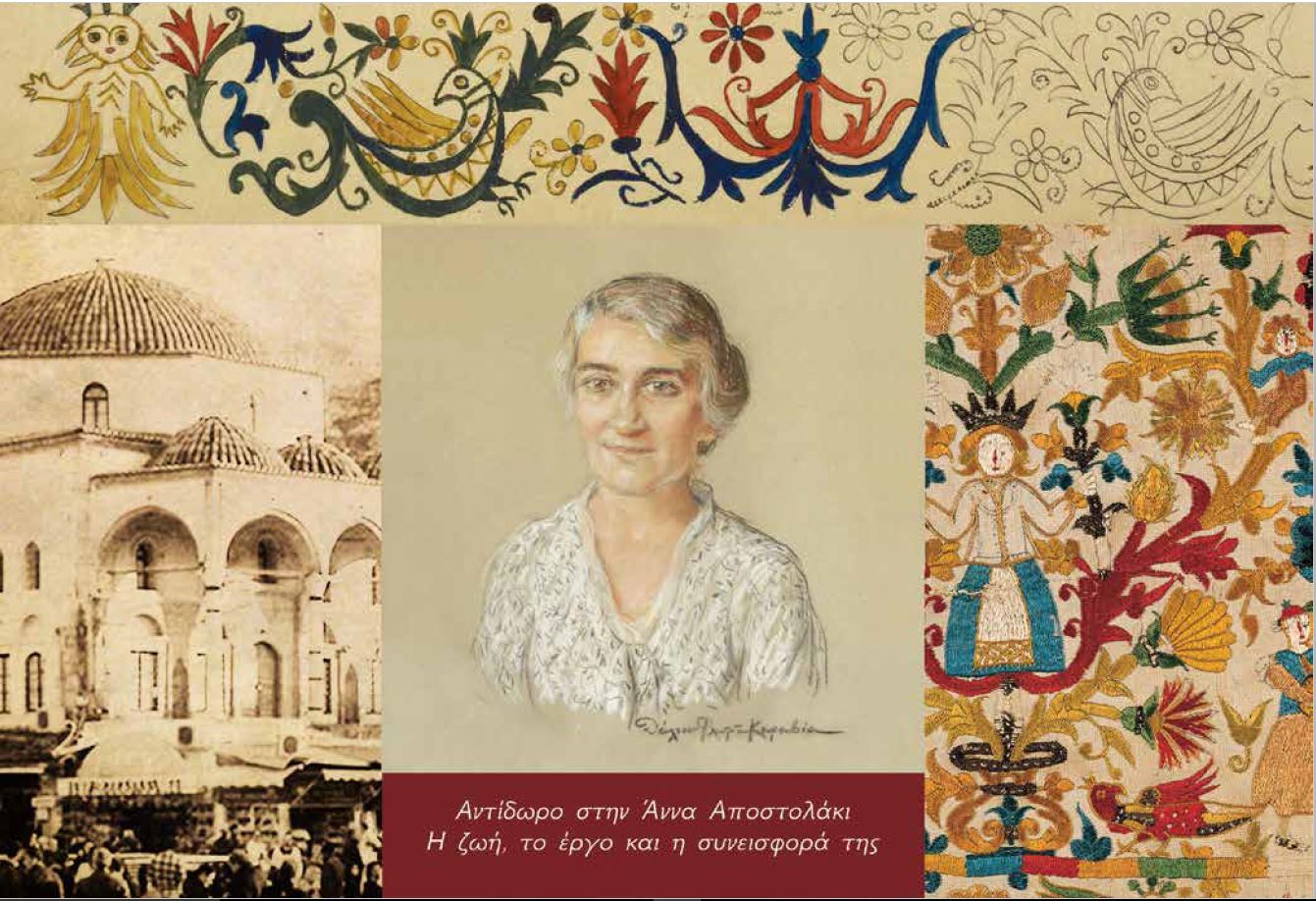
The invite to the conference held at the Benaki Museum on 24 November 2015, organised by the Lyceum Club of Greek Women (Lykeion ton Hellenidon)
Reproduced with permission from Lykeion ton Hellenidon

The cover to the collective volume titled “A Gift for Anna Apostolaki in Gratitude: Her Life, Work, and Contributions.”, published by the Lykeion ton Hellenidon 2 years after the conference
Reproduced with permission from Lykeion ton Hellenidon

The flyer that was produced for the 2015 conference
Reproduced with permission from Lykeion ton Hellenidon
As part of Lykeion ton Hellenidon, Anna Apostolaki collaborated with the Locker Room of the Department of National Costumes. She gave her first lecture to members of the Lykeion on the Palace of Minos at Knossos in 1911 at a time when men dominated the scientific and archaeological world.
In May 1926, the Lykeion promoted a 3-day festival held in the Panathenaic Stadium.The festival created a historic panorama representing all periods of Greek civilisation from prehistory to present. As part of this, Anna Apostolaki personally oversaw the production of Minoan costumes worn by young ladies of the Lykeion – reminiscent of Minoan themes in the Opening Ceremony of the Athens Olympics in 2004. 11 Minoan costumes were created as reenactments of Knossos frescoes, which cost 20,000 drachamas (almost 1/10 of the festival’s budget). The festival, and this aspect in particular, was described as beautiful work of national pride. Kalliroe Parren reported that:

A photo from the 3-day festival in 1926 held at the Panathenaic Stadium, showing young ladies of Lykeion ton Hellenidon wearing Minoan costumes. These were tailored under Anna Apostolaki’s instructions.
Image 20407 from Lykeion ton Hellenidon Photographic Archive, reproduced with permission from Lykeion ton Hellenidon
Upon her death in 1958, Anna Apostolaki left behind 3 books and 11 articles – all that remained followed the Second World War. Nonetheless, her legacy of feminism and nationalism within Greek archaeology cannot be underestimated. A formidable woman and archaeologist, it is undeniable that the legacy of this incredible TrowelBlazer deserves to be recognised.

Anna Apostolaki
Image reproduced with permission from the Photographic Archive of the Benaki Museum
References and further reading:
- ‘Chapter 12: Greek women in archaeology: an untold story’ in Excavating Women
- ‘Anna Apostolaki: A Forgotten Pioneer of Women’s Emancipation in Greece’ by Vivian Florou (2016)
- ‘Groundbreaking women in archaeology’ by Kate Fernie (2021)
- Δελτίον της Χριστιανικής Αρχαιολογικής Εταιρείας (1959)
- ΑΝΤΙΔΩΡΟ ΣΤΗΝ ΑΝΝΑ ΑΠΟΣΤΟΛΑΚΙ: Η ΖΩΗ, ΤΟ ΕΡΓΟ ΚΑΙ Η ΣΥΝΕΙΣΦΟΡΑ ΤΗΣ (2017)
Many thanks to the the Archaeological Society at Athens, Lykeion ton Hellenidon, and the Benaki Museum for image permissions.
Written by Naomi Allman as part of the 2021 TrowelBlazers Digital Fieldwork Project at the Institute of Archaeology, UCL.