Where you live
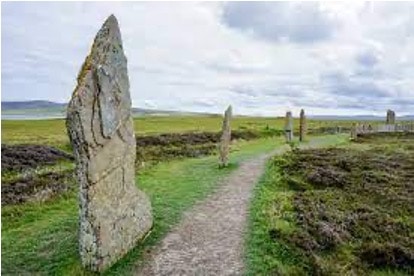
If your parents are archaeologists, geologists or palaeontologists or you live in an area, such as Orkney, surrounded by evidence of past lives, you are necessarily introduced to the subject at a very early age.This might well apply to the daughters of bioarchaeologist Siân Halcrow, seen here at a site in Laos.

Children of an archaeologist. Image courtesy of Sian Halcrow, www.childhoodbioarchaeology.org
Two TrowelBlazer examples are Helen Belyea and Grace Anne Stewart. They were both inspired by the geological outcrops near their childhood homes in Canada to become geologists.
The Jorvik Centre in York is just one example of archaeologists offering children wonderful opportunities to get ‘dug in’. Tiny Diggers caters for babies and toddlers up to 4 years using textures found in archaeology. Older children can dig in mock sites for artefacts from 4 different periods, with a team of archaeologists on hand to discuss their findings.
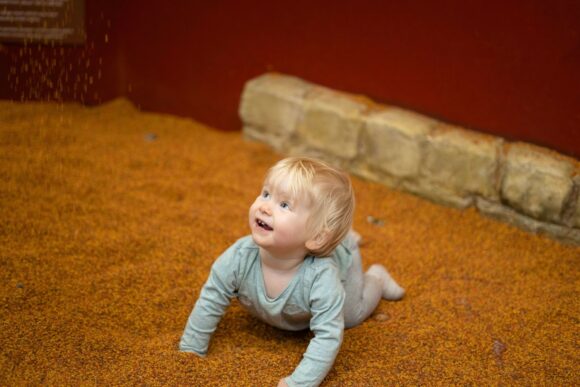
Children at Jorvik Viking Centre’s ‘Tiny Diggers’. Image courtesy York Archaeological Trust.
And occasionally, there’s a chance to actually dig! When Dame Rosemary Cramp was excavating at Jarrow Abbey she asked some local children to help, giving them practical archaeological training in return. Girls were also part of the team employed by the Palestinian Fund Exploration as featured in this post.
Primary School
Many museums and archaeological sites have facilities for primary school children. The Museum of London for example, offers activity packs for very young visitors and loan boxes, containing artefacts from different periods for teachers to use.
The British Museum and the Pitt Rivers Museum offer interactive sessions for primary schools.

Visitors at the British Museum. Image reproduced under CC-BY-NC-SA 4.0 license, copyright the Trustees of the British Museum
Several archaeological sites have resources for teachers. Star Carr has a pack of 9 short stories featuring a megalithic family, each one supported by archaeological knowledge. Fishbourne Roman Palace offers workshops for all key stages and Warwick Castle has numerous artefacts on display, with explanations of their significance and context.
Site visits, class discussion and assessments of artefacts, based on the Collingwood (1946) enquiry approach of what you know, what you guess and what you want to discover, all contribute to an integrated way of learning (Cooper 1991) that archaeology has to offer. Catherine McHarg of Historic England suggests that guiding children through the thought processes used by archaeologists, from vocabulary to concepts of interpreting artefacts, is a valuable exercise. The hands-on experience of artefacts differentiates it from learning history.
The 9 and 10 year olds I interviewed recognised a picture of Stonehenge, had visited Avebury and were aware of the possible use and meaning of stone circles. They knew we all originated in Africa. When asked what they would associate with Cleopatra they cited the pyramids and sphinx, and with Julius Caesar, a chariot and the Coliseum (mainly because of the horrific prospect of people being eaten by lions). It seems a lot of their knowledge came from the Horrible Histories books and television programmes which had captured their imagination.
Secondary School
Archaeology is no longer a GCSE subject but a two year ‘A’ level course is offered by the AQA exam board. However, the arguments, inferences and assumptions used to interpret archaeological knowledge can be applied equally, and at any level, to History, English, Maths, Science and Geography. Arthur Chapman writes:
‘Archaeology offers an accessible way of interpreting aspects of the past pupils find difficult – namely how and why do interpretations change’.
He cites how the meaning and purpose of Stonehenge has changed, and continues to change, over the years as an example.
Physical artefacts enable students to make inferences and deductions offering unique and profound learning opportunities – not just the object itself but its context and meaning. ‘Ordinary Things’ – a lesson plan from UCL Centre for Holocaust Education uses a child’s shoe as an example of how things owned by people in the past open up a different way of seeing and understanding their life and times.
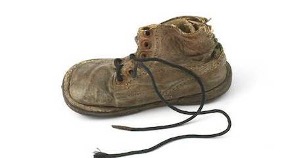
A child’s shoe. Image courtesy UCL Centre for Holocaust Education.
Historic England have a free interactive timeline to help teachers, many of whom have no previous knowledge of the subject, explore Britain’s prehistory from the Palaeolithic to the Roman eras with their primary or secondary school pupils. They also have an online Dig Diary made at Must Farm outlining the skills needed by archaeologists.
Out of School
Dig Ventures for Kids offer Dig camps for parents and children from 6 – 11 years old. 12 – 16 year olds can join the main dig. Their website shows the top 10 discoveries made by Junior Archaeologists in 2019.
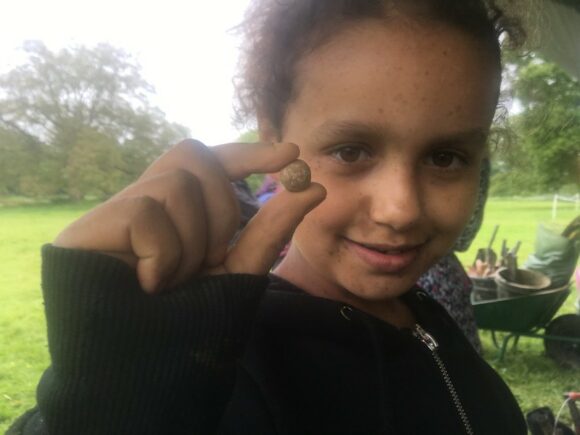
Hannah with a musket ball. Image courtesy of Dig Ventures.
The Young Archaeologists’ Club is a charity, run by the Council for British Archaeology with 70 clubs run by 500 volunteers for 8 – 16 yr. olds. During their monthly meetings they undertake excavations and experimental archaeology as well as handling and assessing artefacts.
BBC Education formally offered several archaeological activities with which to experiment, either as a family or in a group, and these are still archived and available online.
Books
Till this point, unless they attended a single sex school, there has been no gender differential in the archaeological opportunities open to children. When it comes to books, however, there are quite a number featuring girls as the main character. Here are 4 examples :-
Maroo of the Winter Caves by Ann Turnbull, about a 13 year old Ice Age girl who takes care of her family after her father’s death.
Curse of the Mummy – uncovering Tutankhamen’s Tomb by Candace Fleming.
Lisa in Egypt by Lisa Seldenthuis is about a 10 year old girl excavating in Egypt which covers key archaeological topics.
Savage Journey by Allan Eckhert about a 13 year old girl on a dig in South America with her father.
My favourite is The Street Beneath my Feet by Charlotte Guillian – a wonderful book showing all that goes on beneath the very ground we are standing on, reaching down to the centre of the earth.
Almost all the museums and archaeological sites offer enormously imaginative programmes for virtual exploration and learning for children. However, these can only act as tempters – invitations to dig deeper to make real, physical connections with earlier lives through exploration of sites and artefacts.
My thanks to
Michael Young, Emeritus Professor of Sociology of the Curriculum, UCL
Dr Arthur Chapman, Associate Professor, History in Education, UCL.
Hilary Cooper, Emeritus Professor, University of Cumbria.
Jessica and Alice at the Primrose Hill Bookshop.
Isaac (11) and Zia (10) Higham.
References
Collingwood, R.G. (1946) The Idea of History Oxford: Oxford University Press.
Cooper, H. (1991) Young Peoples Thinking in History. Unpublished PhD. London: London University Institute of Education.
McHarg, C. Archive Education Manager at Historic England.
Guest post by Penelope Higham as part of the TrowelBlazers Digital Fieldwork Project 2021
Edits by Brenna