
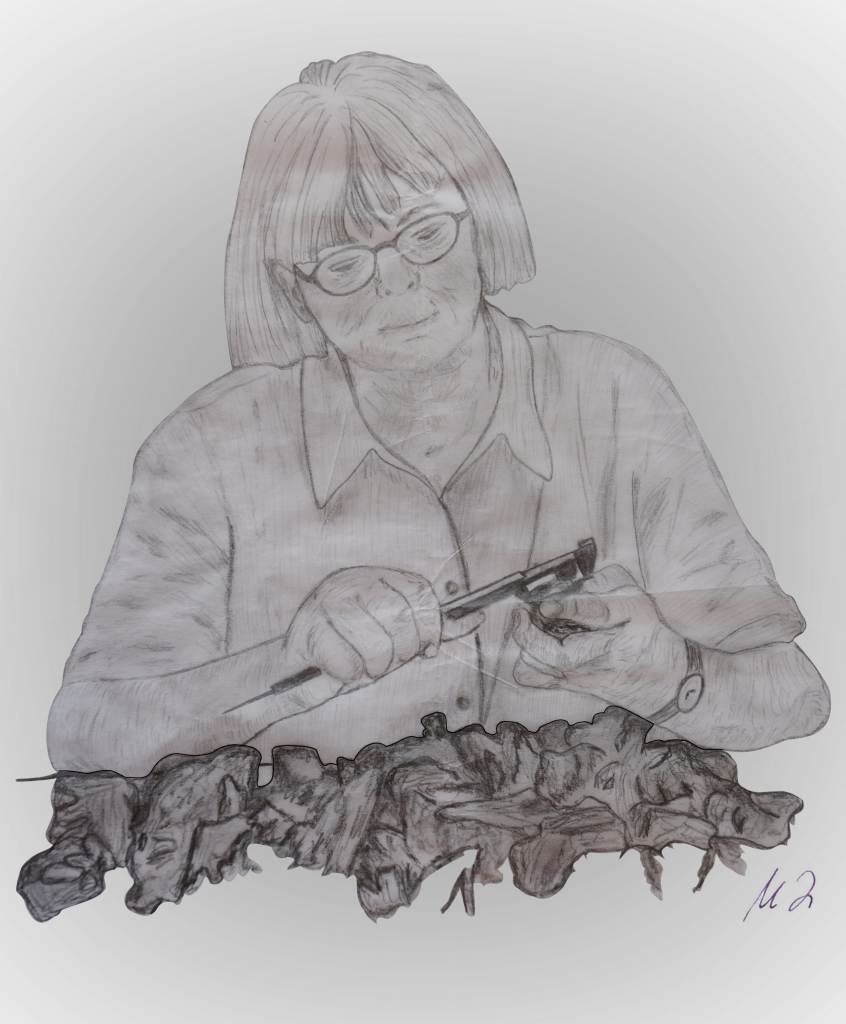
It is no exaggeration to say that Angela Felicitas von den Driesch (née Karpf) was one of the most outstanding and influential archaeozoologists of the 20th century. She was an osteologist, biologist, veterinarian, zoologist, ecologist, and specialist in the history of veterinary medicine. She brought a uniquely inherently interdisciplinary approach to archaeozoology, and was passionate about her profession. Her engagement and enthusiasm inspired many generations of students and she served as a role model for young female scientists. She essentially influenced the development of archaeozoology as a discipline in Germany and beyond, and left a wealth of publications, many of which are considered the foundation of archaeozoological practice.
Born in 1934, she studied veterinary medicine at the Ludwig-Maximilians-University (LMU) in Munich from 1957-1962 and was awarded the degree of Doctor medicinae veterinariae in 1963 for her thesis “Anatomical study of the inner lymphatic system of the testicle”. She then accepted a position as a research assistant at the „Tieranatomische Institut“ (Institute of Animal Anatomy) of the Faculty of Veterinary Medicine, LMU, and left two years later to work at the newly founded „Institut für Paläoanatomie, Domestikationsforschung und Geschichte der Tiermedizin“ (Institute of Palaeoanatomy, Domestication Research and the History of Veterinary Medicine) of the same faculty, under the direction of Joachim Boessneck, a name many archaeozoologists will also recognize. In 1970 she completed her habilitation thesis “Osteoarchäologische Untersuchungen auf der Iberischen Halbinsel” (Osteoarchaeological investigations on the Iberian Peninsula), received her teaching license in 1971 and was offered a full professorship at the institute in 1978. Thirteen years later she succeeded Joachim Boessneck after his sudden and unexpected death of cancer and became chair of the institute until 1999.
During her time at the department she lectured various courses, supervised numerous dissertation theses and published several hundred articles and monographs in multiple languages (German, English, French, Spanish and Dutch). Her most well-known standard works include “Geschichte der Tiermedizin. 5000 Jahre Tierheilkunde” (History of veterinary medicine. 5000 years of veterinary medicine) and “A guide to the measurement of animal bones from archaeological sites” (von den Driesch, A., 1976; von den Driesch and Peters, 2003). The former monograph is the first German language textbook from the post-war period about the history of animal treatment and the veterinary profession with a special focus on diseases and their treatment in Europe and East Asia. The second is key work that standardised methods in archaeozoology. It is her internationally most influential work, which still is basic and standard for archaeozoologists all over the world and sets the standards for all metrical measurements of animal bones to this day. Her archaeozoological studies took her not only to excavations throughout Europe (from Spain and Portugal to Greece and Bulgaria), but also to Africa (Egypt, Morocco, South Africa), East and Southeast Asia (Mongolia, Nepal), and particularly to the Middle East (Turkey, Syria, Jordan, Yemen, United Arab Emirates).

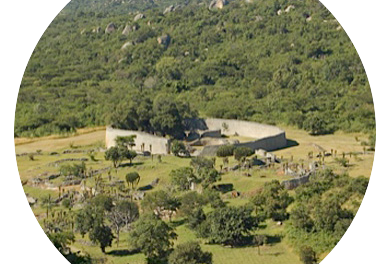
View on Hattusa from Büyükkaya just before the eclipse August 11, 1999. Photo by N. Pöllath.
In archaeozoology her interests ranged from taphonomy, palaeopathology, osteometry, species identification, to the domestication history of horses, cats and dromedaries, as well as the initial steps of domestication in the Fertile Crescent, the archaeozoology of fishes and birds and the cultural history of domestic animals from the onset of the Holocene to modern times.
Her second field of expertise was the history of veterinarian science. In cooperation with philologists, she analysed written and pictorial evidence dealing with animal pathologies and their treatments, the development of the veterinary profession from the beginnings in ancient times to the present, and with diseases and treatment of horses, birds of prey, as well as cattle and camels in Western European and East Asian cultures (China, Nepal, Mongolia).
She was a founding member of the International Council of Archaeozoology (ICAZ) and visiting professor at Pretoria, Cape Town, Phnom Penh, Madrid, at the „Ecole nationale véterinaire de Toulouse“, and Harvard University, Boston. It is therefore all the more astonishing that, in addition to all these tasks, she also was significantly involved in the creation and expansion of one of the largest reference collections in the world, which today contains almost 20,000 reference skeletons of more than 2700 vertebrate taxa, with many exotic or meanwhile rare species.
Working with her in the field was always an adventure. Despite her chronic osteoarthritis, she went on horseback to expeditions in the Himalaya and kayaking in Canada. She rarely returned from the field without new accessions for the collection – either visiting fish markets or collecting fallen animals when hiking on days off. These fresh finds were not always received with pleasure when she cooked and cleaned this “prey” in the kitchen at the excavation houses. The archaeologists were mostly interested but the cooks were rather disgusted.
As a woman who started her scientific career at a time when German women could only take up a job when their husband agreed, it was very important for Angela to ensure equal opportunities for women in science. She fought against the discrimination of women in the academic world and promoted these principles as a women’s representative at her faculty.
She was also a strong fighter for the institute in Munich. After Boessneck’s death the faculty of the university wanted to close down the institute and give the positions and resources to the other larger, more influential institutes. Instead, she successfully invoked colleagues around the world to appeal this decision, as Munich was the only stand-alone institution of that kind in Germany back then. The Institute is still here to this day, and one of the leading institutes for archaeozoology.
Although Joris Peters took over the chair in 1999, Angela von den Driesch never stopped working. Despite some serious illnesses and some physical ailments, which she defied and overcame, she worked full of energy and enthusiasm in her profession and continued to research and publish until her premature death on January 4th 2012.
_
Post by Michaela I. Zimmermann and Nadja Pöllath
The drawing of Angela von den Driesch is by Michaela I. Zimmermann (2020) and the landscape photo was taken by Nadja Pöllath in 1999. Images are used with the authors’ permission.
_
References
von den Driesch, A., 1976. A Guide to the Measurement of Animal Bones from Archaeological Sites, Peabody Museum Bulletin. Peabody Museum of Archaeology and Ethnology, Cambridge.
von den Driesch, A., Peters, J., 2003. Geschichte der Tiermedizin. 5000 Jahre Tierheilkunde. Schattauer, Stuttgart and New York.




Thanks for sharing this wonderful views on an important Archaeozoology character and scientist.
One of my heroines, and delighted to have been instructed by her. A marvellous bio and tribute, and I do like the drawing! Angela pushed forward scientific careers for women in Germany with charm and gusto. Many thanks!
An outstanding person, and not only as a scientist. Zooarchaeology in Spain owes an inmense debt to “la jirafa” (the giraffe, a nickname she got in Andalusian due to her 1.9m).
I am moved to write about professor Von den Driesh because of her very supportive nature to young academics. When I met her I was asking to acquire the thesis monographs on bird osteometrics. She simply asked “are you a student” to which I said yes and on my return to Britain all the in print volumes arrived by post. Very generous, helpful and kind.
I shall always remember how kind and helpful she was to me when I was a mere young student when I visited Schellingstrasse!