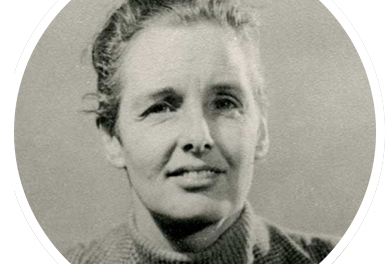
Virgínia Rau (1907-1973) is usually celebrated for her scholarship on medieval history and her illustrious career at the University of Lisbon rather than her archaeological work on Portuguese prehistory. She authored more than 100 publications about the economic history of medieval Portugal, on topics ranging from markets, to merchants, to salt exploitation. At a time when few women held positions of power within the Portuguese academy, Rau rose through the ranks to become a respected professor and, eventually, the director of the Faculty of Letters at her university. Despite Rau’s primary focus on later periods, she developed a strong interest in the archaeology of Portuguese prehistory as a student in the 1940s. She became the first Portuguese woman to publish on archaeology and paved the way for future female scholars within the profession.
Rau was born in Anjos, Lisbon in 1907 to a wealthy, cosmopolitan family. Her father, Luiz Rau Junior, was of German descent and her mother, Matilde Bivar de Paula Robertes Rau, was Spanish. As a young woman, Rau began her studies in the University of Lisbon, enrolling in the Historical and Geographic Sciences department in 1927. After a short time, she left for an extended stay abroad in France and Germany financed by her family. There, she took courses and developed keen research skills through her work in foreign libraries and archives. It was not until the beginning of World War II that Rau returned to her home country, where she resumed her formal studies in 1939.
Back at the University of Lisbon, Rau specialized in medieval history but was also first exposed to archaeological fieldwork. Manuel Heleno, a prominent historian and archaeologist of the era, was one of her professors. Rau never worked closely with Heleno on his archaeological work, despite her repeated requests to accompany him on field research. He did, however, introduce her to the French prehistorian and archaeologist Henri Breuil, who was a visiting scholar at the university in 1941 and 1942. Through this connection, Rau was able to gain her first practical field experiences. She accompanied Breuil on his research trips to palaeolithic sites in Portugal in the Rio Maior region. She also began to study the archaeological collections at the Museum of The Geological Service. There, she developed a close friendship and collaborative research with Georges Zbyszewski, a geologist and archaeologist of prehistory. Throughout this period, Rau maintained her archival research, completing a thesis about medieval Portuguese markets and receiving her first degree in 1943.

That same year, Rau began her doctoral study in medieval history and Heleno hired her as an assistant for practical courses in archaeology. She taught with the collections at the Geology Museum as well as at the Museum of Ethnology with Dr. Leite de Vasconcelos (a predecessor of Portugal’s current National Museum of Archaeology in Belém). Rau’s lessons covered a wide range of topics and chronologies from the Neolithic to the Iron Age in the Iberian Peninsula. During this period, she continued fieldwork with Georges Zbyszewski and her own research on prehistory. Over the course of the 1940s, Rau published five research articles on archaeology, including several that were co-authored with Zbyszewski. Her study of Portuguese prehistory also contributed to the publications of Breuil and Zbyszewski.

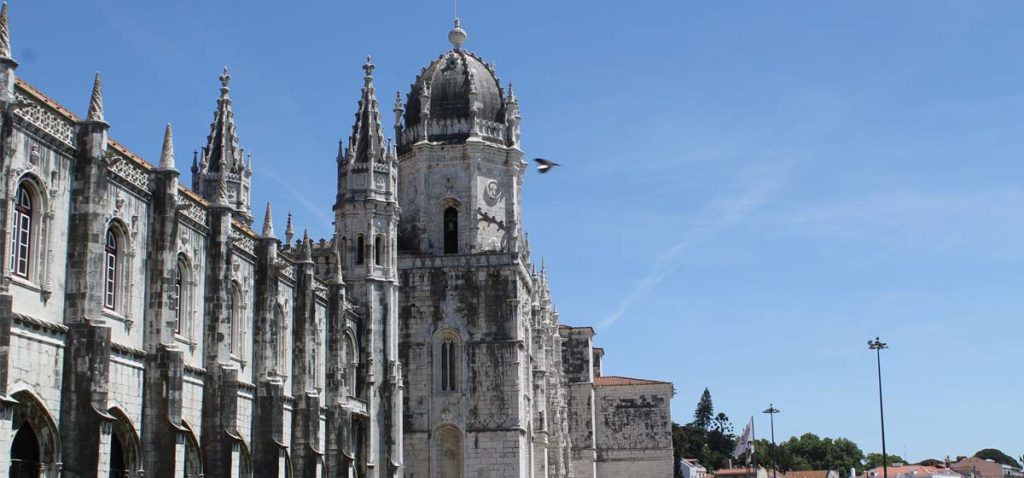
National Museum of Archaeology, Portugal. Photo: L. Gosner
In ill health and under a great deal of stress, Rau resigned from her time-consuming role as an assistant in a letter to Heleno. She taught her last practical course in archaeology in 1946 and devoted herself full-time to completing her doctorate. She received her degree in 1947. Whether her interests simply took her back to archival research permanently or she found it too difficult to break into a career in archaeology as a woman, Virgínia Rau never returned to archaeological work.
She went on to a fruitful career as a historian. She taught for a quarter of a century at the University of Lisbon and is remembered fondly by her students and colleagues. During her career, she traveled widely for speaking engagements and research abroad. In the United States, she spoke at Berkeley, Harvard, Chicago, and Northwestern and even served as a visiting professor at Yale in 1963. Notably, she founded the Center for History at the University in 1958 and became the director of the Faculty of Letters from 1964 to 1969.
Virgínia Rau died in 1973 at the age of 65. Sadly, her name has largely been forgotten in the history of archaeological research in the Iberian Peninsula and in Europe. However, her teaching, research, and leadership at the university have made it possible for many subsequent generations of young women to study archaeology.
Written by Linda Gosner (Twitter: @lgosner)
References
Ávila de Melo, A. and J. Luís Cardoso. 2014. “Virgínia Rau. Uma Medievalista na Pré-História.” Estudos Arqueológicos de Oeiras 21: 511–46.
Cardoso, João Luís, ed. 2013. “Manuel Heleno: Pioneiro do Ensino e da Investigação Arqueólogica em Portugal (1923 – 1964).” Lisbon: Museu Nacional de Arqueologia.
Díaz-Andreu, M. 1997. “Conflict and Innovation: The Development of Archaeological Traditions in Iberia.” In The Archaeology of Iberia: The Dynamics of Change, edited by M. Díaz-Andreu and S. Keay, 6–33. New York: Routledge.
Díaz-Andreu, M., and M. L. Stig Sørensen, eds. 1998. Excavating Women: A History of Women in European Archaeology. London: Routledge.
Fernandes, H. 2017. “Virgínia Rau. Algumas Variações sobre um Cosmopolitismo.” Faces de Eva. Estudos sobre a Mulher 37: 24–39.
Gonçalves, I. 2017. “Lembrando a Professora Doutora Virgínia Rau.” Faces de Eva. Estudos sobre a Mulher 37: 17–20.
Oliveira Jorge, V., and S. Oliveira Jorge. 1996. “Women in Portuguese Archaeology.” Trabalhos de Antropologia e Etnologia 36: 159–67.
Edited by Brenna