

Nieves López Martínez (1949-2010) will always be remembered as part of a group of pioneering palaeontologists who were responsible for the modernization of palaeontological studies in Spain. Born in Burgos, on 5 February, 1949, she specialized in the research on the vertebrate fossil record, with a special focus on small mammals. She contributed groundbreaking research in a number of subdisciplines, including taxonomy and systematics, taphonomy, evolution, palaeobiogeography, and biochronology and biostratigraphy. In addition, Nieves was a multidisciplinary researcher who promoted and supported actively the incorporation of young students in research.
Nieves studied at the Complutense University of Madrid, graduating in Biological Sciences in 1970. Later, her desire for continuous improvement led her to develop two PhD works. She did the first one in France, under the supervision of Dr. Louis Thaler at the University of Montpellier and the second one in Madrid (Spain) under the supervision of Emiliano Aguirre at the Complutense University of Madrid.
Although she was recognized worldwide as a leading figure in the study of the evolution of Cenozoic lagomorphs (rabbit-like animals), she was also an expert in the Cretaceous–Paleogene extinction event in the area of the Pyrenees.
For decades, she was very involved with university teaching programs, both officially at the Complutense University of Madrid and through various projects, such as the Somosaguas Palaeontology Project, which was associated with the middle Miocene Somosaguas fossil site (Spain).
Nieves developed pioneering initiatives in teaching, but also possessed a visionary outlook for Spanish studies in palaeontology, implementing multidisciplinary research without barriers; for example, linking palaeontology and sociology by introducing the concept of “Social Palaeontology”, which sought to develop new techniques for communicating palaeontological knowledge to groups with special needs.
In 2006 she became one of the first full professors at a Spanish university to embrace web 2.0 technologies, participating in the creation of four blogs: Teaching in Vertebrate Palaeontology, Humans and Animals, GeoPalaeoBiological Research at Somosaguas, and Beyond Somosaguas. Her interest for communicating science on the Internet was an example for many others and, as a result, the current Spanish palaeoblogosphere is highly relevant.
Last, but not least, she excelled in university teaching programs, spreading her enthusiasm for knowledge widely and providing several generations of palaeontologists the opportunity to start their careers in scientific research. Her former students, now researchers and professors at the university, are continuing this legacy in the Miocene Somosaguas fossil site as well as in many other sedimentary basins and time intervals.
Written by Manuel Hernández Fernández @HdezFdez and Ana Rosa Gómez Cano @argcPALEO
Edited by Suzie Birch @suzie_birch
Landscape photo credit: Nieves López Martínez followed by a set of students during a field campaign at Somosaguas fossil site. Courtesy of Somosaguas Project of Palaeontology.

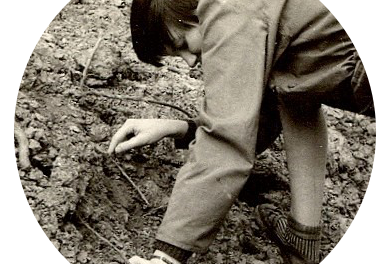


Nieves fue una excepcional maestra y científica, con un dinamismo enorme. Sus estudios e investigaciones por la provincia de Lleida ayudaron muy notablemente al conocimiento de la Paleontologia local y mundial.
Nieves desarrolló una importantísima labor en el conocimiento de la bioestratigrafía del Neógeno español (cuencas del Duero, Ebro, Tajo y otras pequeñas cuencas Terciarias), así como su correlación con otras biozonaciones europeas, consiguiendo la colaboración de más de 20 científicos europeos que fructificó en un magnífico trabajo de síntesis: “Up-to-date Spanish continental Neogene synthesis and paleoclimatic interpretation”.
[translation: Nieves developed a very important work in the knowledge of the bioestratigraphy of the Spanish Neogen (Douro, Ebro, Tajo and other small Tertiary basins), as well as its correlation with other European biozones, achieving the collaboration of more than 20 European scientists who successful in a magnificent synthesis work: “Up-to-date Spanish continental Neogene synthesis and paleoclimatic interpretation”.
———-
By the way, in the photo, next to Nieves is Margarita Díaz-Molina (geologist), it is not Margarita Salas (biochemistry).
Oh my gosh, thank you! Fixed now!!!
Hello,
I just found this… I’d never seen this photograph, but the field of the scientist Margarita Salas was Biochemistry and Molecular Biology,… maybe the caption is a bit confusing?
Cheers!
Our mistake!!!! The woman in the image is Margarita Díaz-Molina, the geologist. Eep! Thanks for pointing it out.